
How to become a videogame voice actor
How to be a videogame voice actor
In a sense, playing a video game and becoming a videogame voice actor can be similar. In both cases, you likely play as a character in a setting. But that’s where the similarities end. Instead of enjoying a fun game, video game voice actors have a whole different job — fully immersing themselves in a character and a world. They have to feel the character’s emotions, know their goals, and express as the character would. Learning how to become a videogame voice actor is quite different from the observer-like experience as a player.
How to become a videogame voice actor
Learn how to act
Excellent acting is what makes a video game voice actor believable. Poor acting, unfortunately, breaks the immersion. So, it’s important to practice acting as your first step, so you can become the characters you want to voice act. Consider taking voice acting coaching lessons, classes, or courses. If you need to change your voice for certain characters, check out our guide on how to make your voice deeper.
Audition and gain experience
Once you’re prepared to audition, practice with some sample scripts and apply for smaller projects. You’re unlikely to get hired right away by triple-A video game companies, and you’re welcome to try, but you’re more likely to land these jobs once you’ve demonstrated you know how exactly how to become a videogame voice actor. So start small and focus on gaining experience.
Develop characters and market yourself accordingly
Many animation and video game voice actors find that their voice naturally gravitates towards certain caricatures of characters, whether that’s the angry teenager, or the final boss. As you gain experience, pay attention to the strengths of your voice, and be sure to market yourself as someone who’s very capable of becoming these characters. You can demonstrate your ability to become a video game voice actor through your samples.
FAQ
Novice voice actors can earn $1 to $5 per 100 words while experienced video game voice actors can earn $50-$200 per 100 words during video game voice acting jobs.
Yes, it can if you aren’t careful. Video game voice acting can require a lot of yelling and screaming, depending on the game. It’s important to prioritize your health and to protect your voice. Consider getting coaching if you struggle with voice acting in a healthy and sustainable way.
"If you want to get into voice-over, wherever you are in the world, start with training. Train to be a voice actor, particularly if you have absolutely no acting background or presenting background."


How to become a voice actor for anime
How to become a voice actor for anime
Anime voice acting is one of the most exciting and competitive niches in the voice over world, especially since 72% of Americans watch anime programs regularly. If you’ve ever asked how to become a voice actor for anime or how do you become a voice actor for cartoons and anime, this guide will give you everything you need—from skills and training to landing anime voice acting jobs and understanding how much anime voice actors make.
What is anime voice acting
Anime voice acting (known as seiyuu in Japan) is the art of bringing animated characters to life with nothing but your voice. Unlike general narration or commercial work, anime voice actors must:
-
Match lip-syncs with on-screen characters (dubbing).
-
Express heightened emotions such as battle screams, exaggerated laughter, or dramatic sobbing.
-
Switch between roles quickly, sometimes performing multiple characters in a single session.
Anime voice acting overlaps with cartoon voice acting but often demands more stamina and emotional depth due to the intensity of anime storytelling. So, in one take, you might need to create multiple screams ranging from stubbing your toe to being blown up. You must also synchronize your lip performances with the on-screen movements when you understand how to become a voice actor for anime.
How to become a voice actor for anime
1. Hone your skills
Anime voice acting involves serious acting, so analyze the performances of seasoned anime voice actors in English and Japanese to familiarize yourself with different styles, character archetypes, and cultural influences.
2. Develop character voices
Research iconic anime voice acting performances. Pay attention to:
-
The “shonen hero” archetype (energetic, youthful, determined).
-
The “villain” archetype (dark, gravelly, sinister).
-
Comedic characters (quirky, exaggerated, cartoon-like).
Understanding these archetypes helps when auditioning for anime voice acting jobs.
3. Research culture and language
When learning how to be a voice actor, research Japanese culture and customs to understand common phrases, honorifics, and references. This will help you accurately portray characters with your vocal style and tone.
4. Create professional voice over samples
High-quality voice over samples or demos highlight your range, talent, and ability and showcase your proficiency in anime voice acting. Include excerpts from anime-inspired scripts or reenactments of iconic anime scenes.
5. Attend workshops and conventions
Workshops, seminars, and conventions focused on anime voice acting let you network with industry professionals and fellow voice actors to gain insights on how to be a voice actor for anime.
6. Stay persistent
Anime voice acting requires patience, perseverance, and resilience. You’ll face rejection and setbacks along the way but remain committed to learning how to be a voice actor by pursuing your passion for anime voice acting.
7. Build an online presence
Social media platforms and networking sites let you share updates about your projects with audio samples or character reels to engage with fans and industry pros. You can also build a profile on Voice123 and make free samples to showcase your voice over skills.
How to get anime voice acting jobs
Anime voice acting jobs can be competitive, but here are proven ways to get started:
-
Online Casting Platforms
Sign up on platforms like Voice123, Casting Call Club, or Crunchyroll to audition for anime dubbing and cartoon voice acting roles. -
Freelance Opportunities
Many indie anime creators post auditions on Twitter, Reddit, or YouTube communities. -
Social Media Networking
Follow studios, directors, and anime production houses on LinkedIn and Twitter. Casting calls for anime voice acting are often shared here first. -
Work with Student Animators
Collaborating on student or indie animation projects builds your portfolio and gets your name into the industry. -
Agencies & Talent Representation
Once you have a strong portfolio, voice acting agencies can connect you with larger anime productions.
How much do anime voice actors make?
As of 2024, anime voice acting pays $48.17 hourly, $1,926 weekly, $8,349 monthly, and $100,198 yearly. The average monthly salary ranges from as low as $917 to as high as $13,333. Depending on skill and experience, anime voice actors earn between $50-70k per year.
Anime voice acting salaries also vary depending on experience, studio, and role. Here’s a breakdown:
-
Beginner Anime Voice Actors: $50–$70 per episode.
-
Mid-Level Talent: $200–$500 per episode.
-
High-Level Professionals: $500–$1,000+ per episode.
-
Annual Salary: Anywhere from $20,000 to $100,000+ depending on volume of work.
Some famous anime voice actors also transition into video game voice acting and cartoon voice acting, which typically pays higher rates.
Example: Tara Strong (known for anime and cartoons) has a net worth of $12M, while Troy Baker (anime, games, and cartoons) has a net worth of $6M.
Famous anime voice actors
- Crispin Freeman: Known for his versatile anime voice acting style, Freeman has voiced characters like Alucard in Hellsing and Itachi Uchiha in Naruto.
- Tara Strong: Though widely recognized for her work in American animation, Strong is also a talented anime voice actor. She voiced Kaya in Princess Mononoke and Rikku in the Final Fantasy video game series.
- Yuri Lowenthal: With a broad range of anime voice experience, Lowenthal is best known for voicing Sasuke Uchiha in Naruto and Yosuke Hanamura in the Persona video game series.
- Vic Mignogna: As another famous anime voice actor, Mignogna is best known for voicing Edward Elric in Fullmetal Alchemist and Broly in the Dragon Ball series.
- Steve Blum: With a distinctive gravelly voice, Steve Blum is best known for his role as Spike Spiegel in Cowboy Bebop and Orochimaru in Naruto.
Tips for success in anime voice acting
1. Continuous learning
Never stop perfecting your craft by attending workshops and taking voice over courses. Anime voice acting is dynamic, and staying updated on industry trends and techniques can give you a competitive edge.
2. Health and well-being
Your voice is your most valuable asset, so prioritize your well-being by staying hydrated, avoiding excessive throat clearing or shouting, and doing warm-up exercises to prevent strain.
3. Adaptability
When learning how to become an anime voice actor, experiment with styles like comedic and dramatic by adapting your performance to suit different tones and contexts. This will improve your emotional flexibility.
Conclusion
If you want to know how to become a voice actor for anime, the key is training, persistence, and exposure. Build strong demos, audition regularly, and stay active in anime and cartoon voice acting communities.
Anime voice acting is not just a career—it’s a chance to bring beloved characters to life and connect with global audiences. Whether you start small with indie projects or aim for big studio productions, dedication and passion will drive your success.
FAQ's
According to ZipRecruiter, the average anime voice actor salary is $48.17 hourly, $1,926 weekly, $8,349 monthly, and $100,198 yearly. The average monthly salary ranges from $917 to $13,333.
You get hired by auditioning on casting platforms like Voice123, Crunchyroll, or Casting Call Club, networking at conventions, and building strong anime voice over samples.
Yes, anime voice acting is competitive. It requires persistence, strong acting skills, and networking to stand out in the industry.
Rates vary by project. For anime, beginners may earn $50–$100 for a 30-second clip, while pros charge hundreds depending on the production budget.
"Though most successful voice actors working in anime today started their careers as voice actors without any specific training in the field, almost all of them did begin their careers with certain things in common. Among these are acting experience, vocal range and the ability to assume and maintain a character. A voice actor is first and foremost an actor."

How to get better at voice acting
How to get better at voice acting
‘Better’ can mean many things. You may have an excellent voice, but poor marketing skills. Or, great marketing skills, but your voice overs could improve. So, here are four practical voice over tips to help you learn how to get better at voice acting.
Voice acting tips
Improve your voice overs
First, start with the technical basics. Keep a far enough distance from the mic. Make the most out of your editing, mixing, and mastering. Reduce the plosives and mouth clicks in your recordings. Then, set up your recording environment to be as soundproof as possible.
Optimise your online presence
Fill out your voice acting online profile and use relevant SEO keywords. Next, market the sound, tone, and personality of your voice. Mention what your voice can do, and what it has done. But be specific and sell your strengths. Moreover, link your social media & websites so clients can easily find you online!
Consider investing in coaching
Getting professional coaching can be very helpful. Sometimes, there are genre-specific needs that are hard to know without experience in the field. Coaches can also help you prepare for a real-life working scenario, and provide advice and tips on how to get better at voice acting.
Invest in better equipment
From time to time, it is wise to upgrade your business equipment. Some mics are better suited for some voices than others, so there’s a chance that changing to a more fitting mic might bring you more success. And make sure other equipment in your recording chain is up to professional standards.
FAQ
No, it’s not a necessity, but a recommendation. What’s important is studying and research. If you don’t invest in coaching or classes, it’ll be hard to succeed in voice acting without researching the industry via books and community forums.
No, it’s about the voice actor, not the tools. You could give a person who has zero experience voice acting the most expensive mic there is, but it won’t teach them how to get better at voice acting.
No! Your unique voice has a place in the industry — as long as it follows the fundamentals of voice acting such as clarity and proper enunciation.
Do your best to improve your voice overs and online presence. You can also invest in coaching and better equipment to help you achieve longevity in your voice acting career.
"The best way to improve your voice is to become conscious of it and take lessons. This may involve sessions with a speech therapist, coaching, or signing up for toastmaster workshops ... the more you become aware of your voice and the more you work with it, the better it will become."

What you need to showcase on a successful voice actor website
What you need to showcase on a successful voice actor website
A great voice actor website is all about simplicity and focusing on the fundamentals.
This piece will break down key tips and strategies to build a successful website to showcase your voice over skills.
A voice actor website is your online business card on search engines. That’s why your voice actor website needs more than a few voice samples and an email address. To speak for you when you can’t, voice over artist websites should include demo reels, additional services, experience, skills, and glowing testimonials from past projects. But that’s easier said than done, right? So, here’s everything you need to know to create an outstanding voice actor website.
"Websites are going to set you apart from the field because it creates more professionalism. If you don't have a website in 2021 that's certainly an issue." - Nicholas Scalice, Founder of GrowthMarketer
What is a voice actor website?
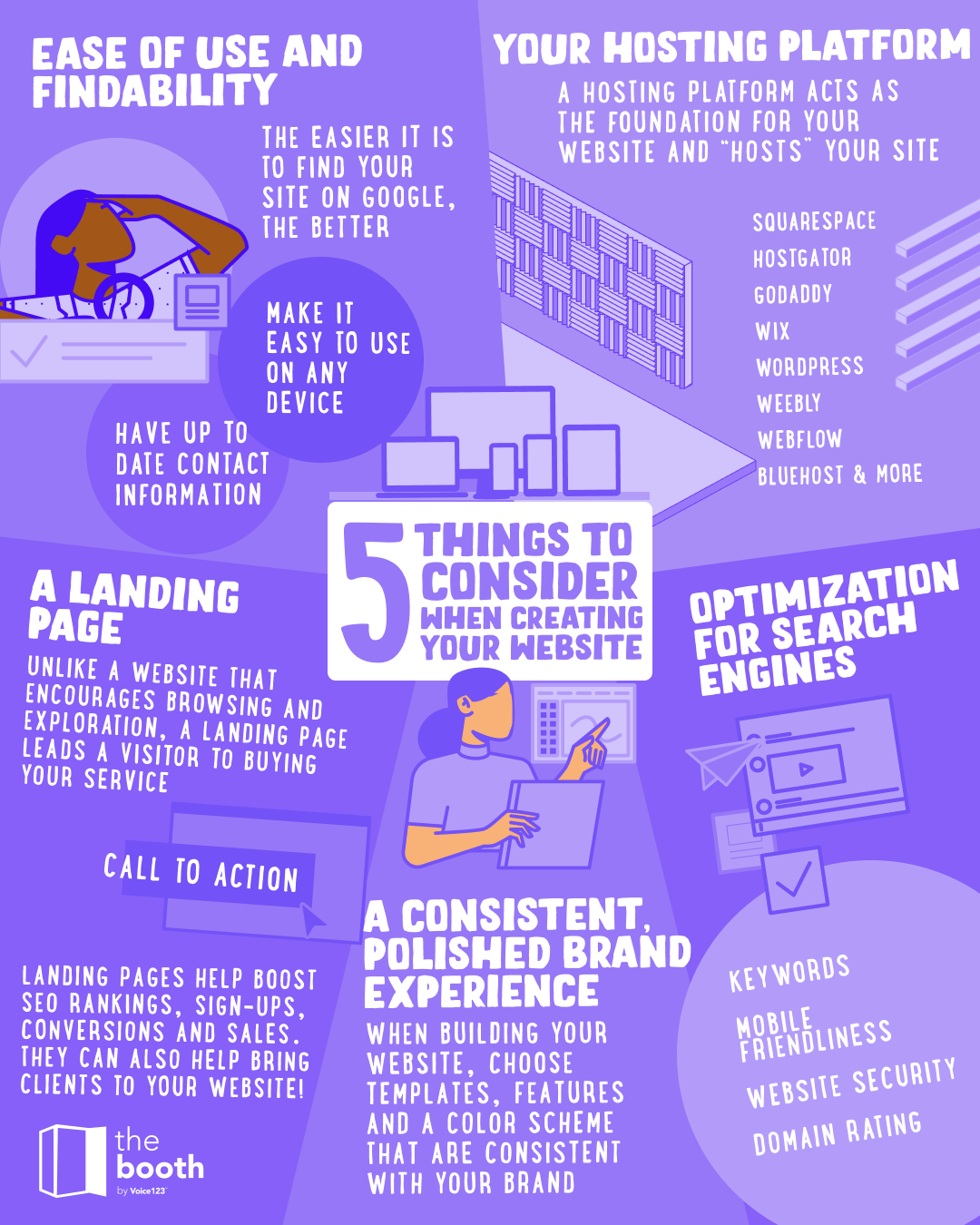
A voice actor website is your online profile to showcase your bio, vocal talents, experience, services, contact info, blog (optional), and testimonials for potential clients. It should be easy to find on Google, easy to navigate on any device, and have a landing page with a call to action such as ‘Book Amelia’s voice for creative commercials.

Voice actor websites introduce clients to the person behind the voice, so the design and content must also complement your voice over persona and values – painting a professional image of credibility with potential clients.
How to build a professional voice over artist website
Creating voice actor websites is like building a house – it takes time, research, and good-quality materials.
Here are 5 steps to building professional voice actor websites:
- Host your website with WordPress, Squarespace, and Wix. These platforms have pre-made website templates to help you start a voice over career.
- Use CMS like Weebly, Joomla, and Drupal to easily upload audio files, create a portfolio, and integrate contact forms.
- Choose a design with colors, fonts, layouts, and a professional theme that reflects your brand identity and niche.
- Include contact info like a bio, demo reels, contact details, testimonials, and an optional blog section with links to your social media or podcast.
- Improve SEO by optimizing page titles, meta descriptions, and headings with keywords and creating descriptive alt tags for images.
To learn more, Voice123 spoke with Nicholas Scalice, a growth marketing consultant on this subject. He highlights three essential factors for successful voiceover web design.“One, you have to have a great offer; a free consultation or, in the case of voice acting, a unique approach that you bring to the table. Two; clear messaging. So you’d want to avoid confusing terminology. Third, effective calls to action. A button, form, or link to give you a phone call; something that lets people know this is the next step.”
Boost your voice over work opportunites with a paid Voice123 membership
First-time paying members are eligible for a discount
How to craft a voice actor website landing page
A landing page is like a drop pin taking visitors to an exact page. With their streamlined design and compelling messaging, landing pages are ideal for voice over portfolios and CTAs encouraging clients to take specific action, like hiring you for a project. Try to be creative and strategic with your landing page; use inviting visuals, convincing demo reels, and compelling copy to make your brand more visible online and contribute to business growth.
How to give your voice actor website exposure
- Join Facebook groups, Edge Studio’s community forum and their Share your VO accomplishments section, or the Voice Acting Discord. Voice123 also lists communities and groups on our voice over resources page.
- Share your website URL on your Twitter, Instagram, and LinkedIn profiles, and use social media to interact and connect with industry professionals and potential clients.
- If you have a Voice123 profile, you can add your website URL to your voice over profile and ensure it’s completed and optimized with SEO keywords.
- Social media management tools like Hootsuite or Buffer can help you schedule posts, monitor engagement, and track mentions of your website.
- Guest blog on voice over artist websites or podcasts in related industries to share your expertise, promote your website, and reach new audiences.
Networking suggestions from Voice Actors
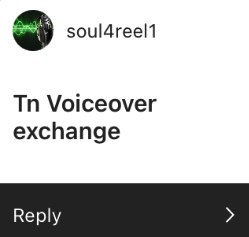
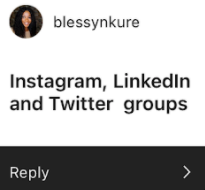
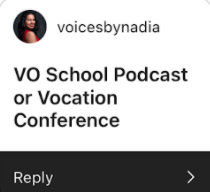
"Most of my work has come from my own marketing efforts … email marketing to different companies, and when I don’t get a response, I pick up the phone and call them. Because I speak two languages fluently, I am a part of different chat groups/WhatsApp groups, and I get a lot of artists referring me to companies." - Pippa Vos, Platinum member on Voice123
SEO strategies for voice over artist websites
When someone types SEO keywords into a search engine, it filters millions of results, providing the most valuable ones. Optimizing your voice actor website pushes your information to the front of the line.
- Keyword research identifies voice over terms potential clients use during voice actor searches. Incorporate them in your website titles, headings, meta descriptions, and image alt tags.
- Create applicable content for your bio, portfolio descriptions, blog posts, and demo reels that attract, inform, and encourage visitors to spend more time on your website, signaling to search engines that your site is authoritative.
- Use security measures like SSL certificates to make your voice actor website trustworthy. Secure websites are favored by search engines and are more likely to rank higher in search results.
- Take advantage of Voice123’s platform education resources for voice actors. You’ll learn valuable SEO insights and tips for optimizing your profile and samples to enhance online visibility and attract more clients.
Resources for voice actor websites
- Village Green Studios has unique designs reflecting a voice actor’s individuality. They focus on branding voice over artist websites with usability, visual appeal, and functionality.
- The Voice Actor’s Webmaster offers customized website solutions prioritizing user experience, navigation ease, and optimization for search engines for maximum visibility.
- VO Site Pro offers mobile-optimized voice actor website examples that provide voice actors with a strong online presence by focusing on search engine optimization that attracts more clients.
- Gabby Nistico focuses on strategic branding and messaging techniques to help voice actors create a distinct online presence with logo design and website content.
Conclusion
A successful voice actor website features thrilling designs, content, and SEO strategies that are continuously updated. Stay informed about the latest trends and industry developments when optimizing for search engines, and actively network to raise your exposure. Voice123’s platform education resources offer valuable insights and guidance for voice actors looking to build and showcase portfolios effectively.
Start building a voice actor website that lets your voice be heard!
Get special deals when you sign up for these resources!

Gabby Nistico
Sign up now and receive a $200 discount using the code VOICE123.
VO Site Pro
Mention Voice123 when contacting Keith, and receive $100 off your voiceover website.

Sign up via this link for a 20% discount on your voiceover web design.

The Voice Actor's Webmaster
The first 100 Voice123 customers will receive 50% off our website setup fee! All other Voice123 customers will get 25% off our website setup fee.
FAQ's
Choose a reliable web hosting service like WordPress, designing a website that showcases your samples, bio, portfolio, and contact information. Optimize your website for SEO and update it regularly with new samples, testimonials, and professional achievements.
Yes, with online casting platforms like Voice123, you can audition for projects online and use a home studio setup to record voice overs and send them to clients online.
First, hone your vocal skills, invest in a quality home studio setup, and establish your online presence with a compelling voice actor website and profiles on casting platforms like Voice123. For more info, check out our guide on how to get into voice acting.
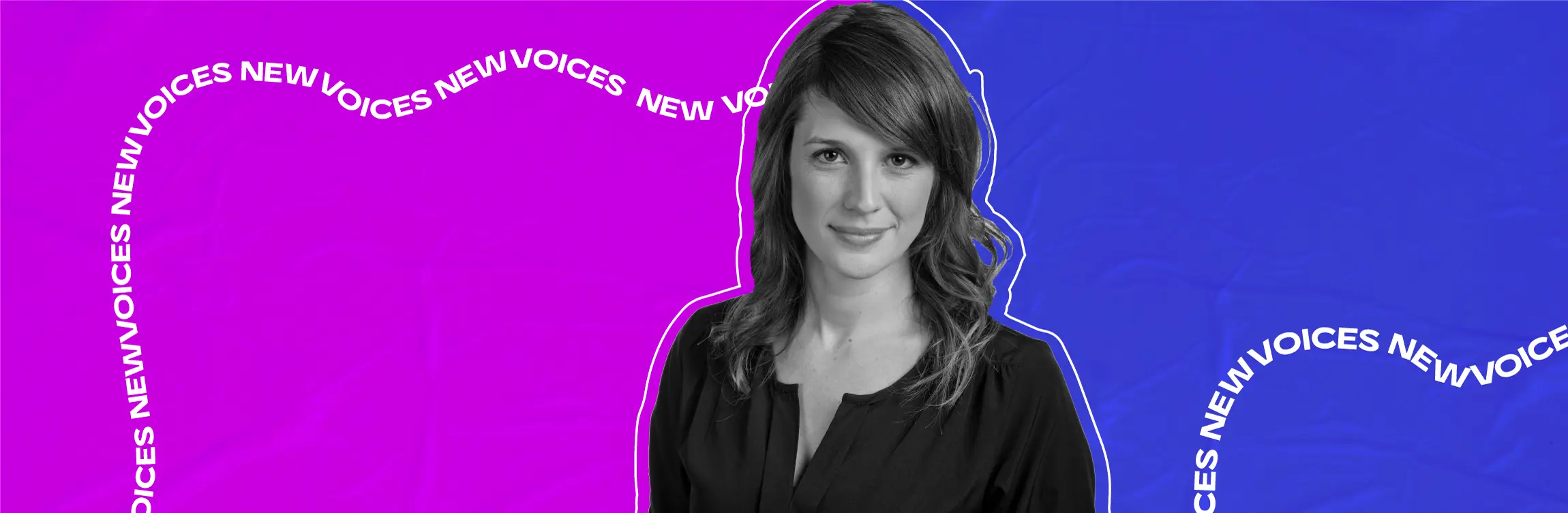
New Voices with Evelyne Audet
New faces, new people, new stories — this is New Voices.
From TV hosting to radio and journalism, you’ve had an impressive journey. How and when did you decide to start a voice acting career?
At first I was hesitant because in the province of Quebec, everything about voiceovers feels like a closed market. It’s really hard to get in and to make a living out of it.
But I thought, maybe it’s a closed market here, but people outside might need a French Canadian voice. So I did some research and found Voice123. And everything rolled from there, putting together a playlist, applying for some jobs and getting my first job.
And doing it from home, it’s quick, simple and easy.
You kind of just tipped into the next question, what kind of equipment and voice acting microphone do you use?

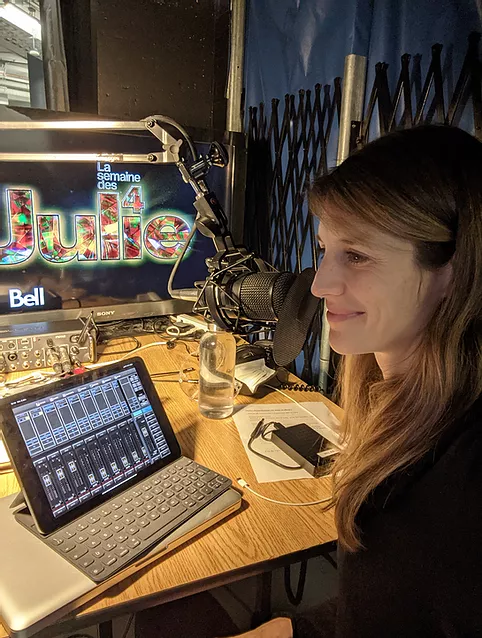
I researched for a long time before I found the right voice acting microphone. I was thinking about making a real studio, but the costs are crazy. Then my boyfriend found a voice acting microphone called the Kaotica Eyeball. It produces a boxy sound and only costs about $100 – very portable and easy to use.
And then I use Audacity to reduce the background noise.
There are a lot of similarities between your past jobs in the entertainment industry. What are some noticeable differences you've found between them?
It’s interesting because first, I studied to become an actor, then I became a TV host. And In the meantime, I realized that everything that I learned about acting is useful in hosting, but they are not the same thing. They all add up but they are really different, and it’s the experience in both that helps me pinpoint my strengths and weaknesses.
It’s the same with starting a voice acting career. I feel very comfortable with a more corporate kind of project, but if it requires too much acting, I know I have some limitations.
All those years of experience in acting, as well as hosting, they all intertwine together. I know what kind of tools I have in my backpack and how to play around with them.
One of those experiences is writing, and even winning awards for some articles. As a storyteller that is also voice acting, what kind of stories are you most passionate about and what would be your dream script to narrate?
I’m interested in long-format projects like audiobooks. I did some auditions, but haven’t gotten any contracts yet. It’s scary at the same time because doing voice overs for 2, 3, 5, 10 minutes is one thing. But when you have to do 40 hours?!, How can you be consistent? How can you maintain the same exact voice or tone and same spirit on the first day of the recording?
But it’s an experience that I would love to do at some point.
There's a lot of encouragement to just be good at one thing and to give it your 100%, but you've clearly gone against that. What advice would you give to the younger generations - be a jack of all trades, master of none?
My answer might surprise you, but I would advise them not to do what I did. Cause you’re right. I love a lot of things. But it was harder for me to get there. Because I’m good at everything, but I’m not excellent. I’m not the best at one thing. Every time someone has to hire someone, they don’t think about me as the first choice. So my name spins around, but that’s about it.
I’ve worked very hard now that I’ve found what I want to excel at.
So I would say: yes, multitasking is really awesome for a lot of things in life, but for a voice acting career, you’ve gotta find what identifies you.
What are your biggest learnings from 2020?
Next year, it’s going to be 20 years since I began in the entertainment industry.
When I started studying TV hosting, everything I learned was about presentation and articulation. That was good and that was enough. But in 2021 people don’t want that. They want personalities. They want real people., it might be someone that’s not perfect but has a great personality.
So there’s less jobs for people like me. I have to detach from everything I learned in the academy and get back to who I am. That’s one thing I wish I knew before.
In 2020 I lost all my contracts and I had given birth months before. I had been out of the market for a year when the pandemic began. It was really hard.
Now, every time that someone gives me a chance to work, it’s a privilege. Before it was just my job and it was okay. But now every time someone gives me the opportunity to lend my voice, I’m grateful in ways I wasn’t before.
Special thanks to Evelyne for sharing her experience on starting a voice acting career.
Check out Evelyne's profile here! And listen to her most recent voice acting work:
Check out our new section with tips and advice as we bring you Ask the pros
Share this post!
A blog owner yourself? Relevant links to quality sites will help your performance on search engines. If your readers will benefit from the services or information on The Booth's Voice over Guide, please consider linking to this post or the guide itself.

The 2021 state of AI voices report
It won’t be long before AI voices are in the same marketplaces as human voice actors, fulfilling voice over jobs that people would normally fulfill. Read on for industry insights that’ll be relevant for voice actors who want to stay ahead of the curve.
The rising force of AI (artificial intelligence) voices finding its place in the voice over industry is a revolution that can have serious implications- and it’s already happening. At Voice123, being proactive about the future helps us continue to make a fair and equitable platform for voice clients and voice actors to interact, embodying transparency along the way. That’s why during 2020 & 2021, Voice123 ran an AI voice over experiment featuring AI characters, and now, the results are ready to be shared publicly for those interested in the rapidly-incoming future.
Curious about the current state and future projections of AI and synthetic voices in the industry?
What is an AI voice?
First order of business is understanding what a synthetic voice is. A synthetic voice is the artificial production of speech, otherwise known as speech synthesis. It involves a text-to-speech (TTS) program, which takes written text, and turns it into audible speech.
If you’ve ever used Google Translate, and clicked the ‘Listen’ button in your translation, you’d hear a synthetic voice.
So, an AI voice is a type of synthetic voice. What makes them different is that AI voices have the ability to learn with ‘deep learning’, a function that enables the AI to mimic the human mind in terms of detecting objects, recognizing speech, and making decisions. The result is an AI voice that can adapt more than a synthetic voice, by merely improving the intentions and emotion it’s portraying. The final objective of AI voices is to sound as realistic as possible. Varying expressiveness, attitude, and sentiment will only help them improve and be considered as characters – machines and voices with their own identities.
How do AI voices compare to human voices?
You may be surprised to learn that AI voices are starting to sound resoundingly human. Take a look at Faith, the AI voice over that went viral in 2020 as “the first AI that can cry.” Faith is incredibly emotional, realistic, and it’s hard to tell that it’s a synthetic voice.
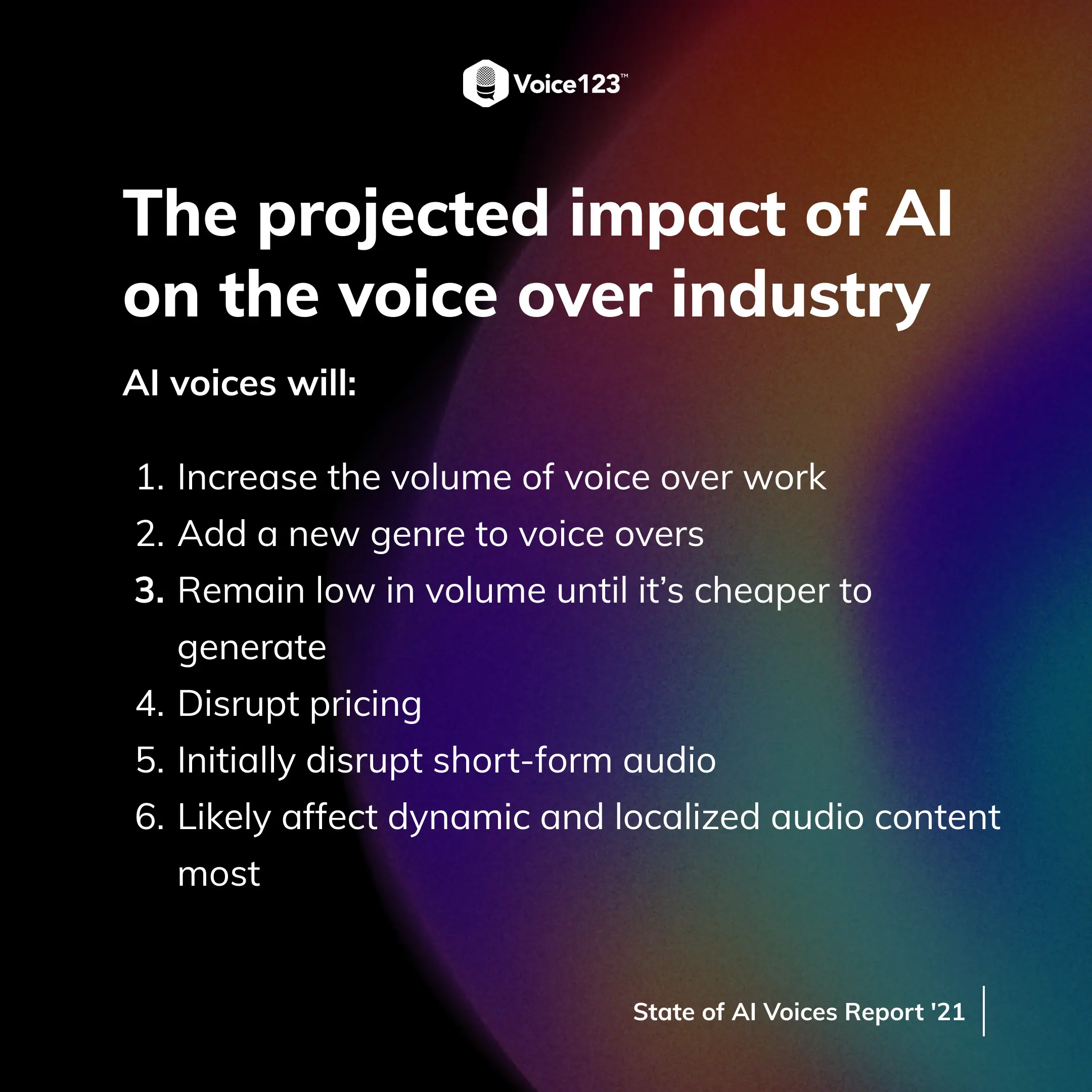
So can synthetic voices hold their own against real voices? The answer is gradually becoming a yes. AI and synthetic voices are most effective with short-form content. Longer content tends to require more work and management.
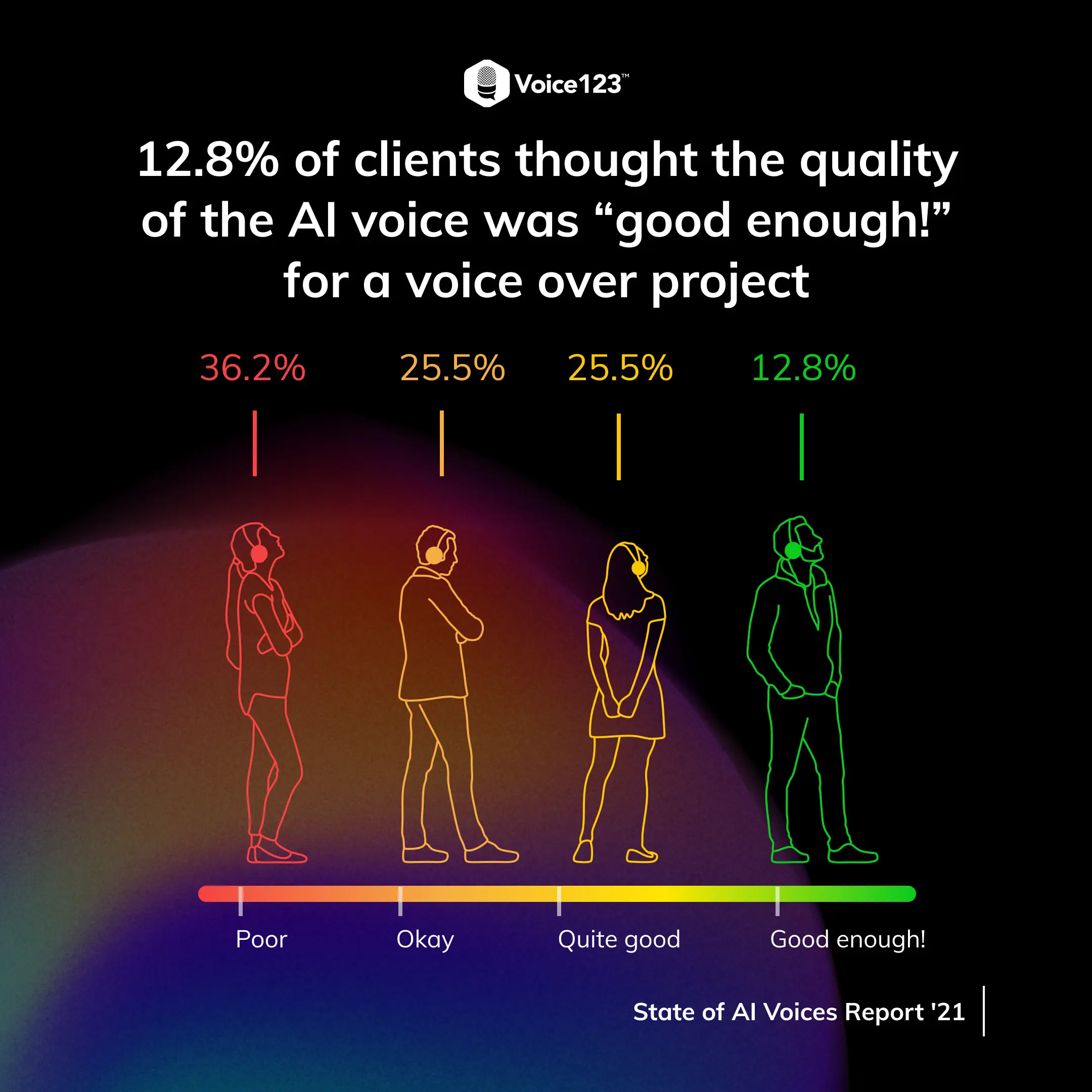
It seems it’s not a matter of if synthetic voices are going to fulfill voice over jobs, but when. In the AI character voices experiment, Voice123 found that 8.6% of clients said that our AI voices were hireable.
In the AI character voices experiment, Voice123 found that 8.6% of clients said that the AI voices were hireable. Share on XThat’s not a grand passing grade, but it’s something. Until technology improves, they’ll still have their drawbacks. You can learn more about our findings and statistics in our full report.
How will AI voices be used?
AI voices will be used across a variety of voice over genres and jobs. Wherever a human voice is used, there’s a chance a synthetic voice could be used instead. Although currently, the scope of that is small, given technological restraints.
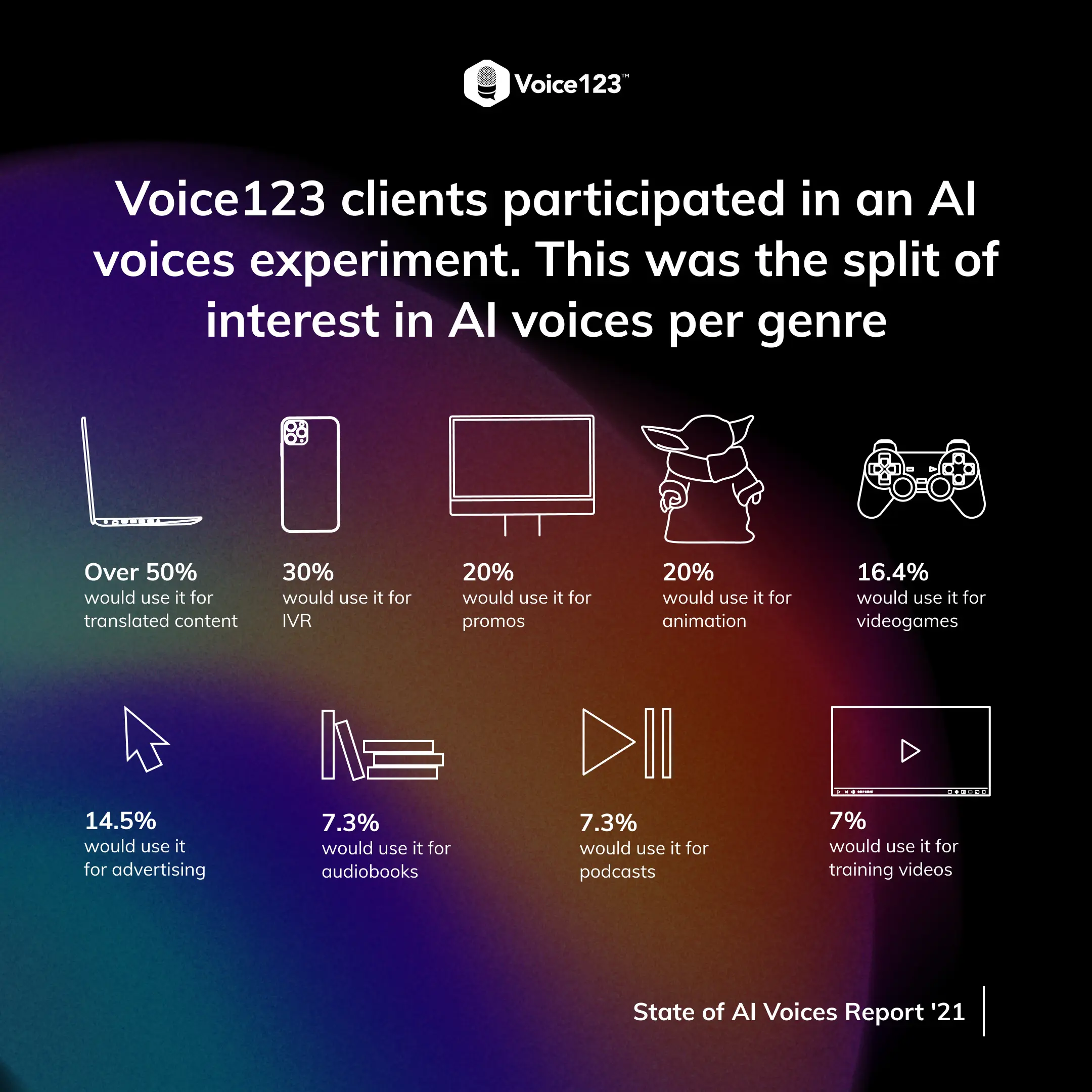
Still, more than half of clients in our experiment said they would use our AI voices for translated content. 30.9% of clients would use it for IVR, interactive voice response.
You can see what other clients thought about other genres of usage in voice over projects in our full report.
Generally, AI voices are currently most appealing for jobs that don’t require great acting ability. Voice clients are looking for fast turnarounds, high-quality voice over, and ease in working together. AI voices offer that capability.
As for voice actors, AI voices can significantly expand their voice acting businesses. They can have ownership of their synthetic voice, and license it as they please. This means they have the ability to have their AI voice working on one project, while the voice actor fulfills another.
This also means voice clients have access to AI auditions, creating a new kind of voice over project.

The future of AI is here.
In the coming months and years, Voice123 plans to rise with the voice over industry on a pillar of transparency, offering a wide range of complementary AI solutions that can help both voice actors and voice clients grow safely in uncharted territory.
The implications of AI and synthetic voices on the industry are huge. Voice123 plans on being a step ahead, paving the road. If you’d like to join us on our journey, be sure to keep up to date with Voice123 and our work! And if you have any questions, please feel free to contact us here.
Share this post!
A blog owner yourself? Relevant links to quality sites will help your performance on search engines. If your readers will benefit from the services or information on The Booth's Voice over Guide, please consider linking to this post or the guide itself.

New Voices with Steve and Gabrielle Paquette

New faces, new people, new stories — this is New Voices.
How did Gabrielle discover her passion for voice acting?
Steve: “I have my own communication agency where we do a lot of voice overs. Lately, I equipped myself with sound equipment, professional microphones, and all that.

And one day, I turned to Gabrielle and said, “come on, sing something in front of the microphone to help me test it out.” Then I said to her, “read from this book” and it was there that I realized how talented she was. At first, it was a bit difficult for her because she’s shy. But then I discovered that in front of the microphone, she was able to speak well and articulate every word.
Obviously she sometimes gets stressed out and a little scared about the final result, but at the same time, she likes it a lot and this allows us to work together and do a good job.”
It’s pretty obvious at first that Gabrielle is very shy, but that doesn’t stop her from listening keenly to every question and every answer her dad gives. We watch her closely, expecting to understand the nature of a shy kid that at just 10 years old, seemed to stand in front of a microphone without fear. So, we decided to turn some of the attention towards her.
What other interests do you have (Gabrielle) and Steve, how do you help her pursue them?
Gabrielle looks shyly at her dad and starts whispering. She thinks for a few seconds as he patiently waits for her to answer. This small interaction surprises us and we start to feel like something really special is happening here.
Gabrielle: “I like to do crafts with cardboards. Also sewing.”
Steve: “She likes to draw too.“
What’s your favorite thing about becoming a voice actor as a kid?
Gabrielle: “I like to make cheerful voices. I also like to edit when we record, when we take the best parts of what I record… and.. yes, I do love to edit what was recorded.”

What do you want to be when you grow up? (Gabrielle)
Gabrielle: “I would like to continue doing voice acting and become a professional, and I would also like to learn about how to better care for the planet.”
After that, Gabrielle goes on and tells us more about the kind of equipment she has at home. She’s proud of her set-up, like every professional voice actor when talking about their gear.
Gabrielle: “We have a microphone, some headphones, there is also a computer for editing afterwards.”
Steve: “I can go deeper into this. We have a Neumann TLM 103 microphone, we also have a booth. I have a studio at my agency where we record. Besides this, we work with Adobe Audition, which is not bad at all because it has good configurations.”
As the conversation advances and much of the father-daughter relationship is revealed, we really start to understand how the dynamic between Steve and Gabrielle goes and what the real intention is behind their decision to start doing voice overs.
Steve: “Maybe she will do this professionally in the future, but right now, it’s all about having fun and but also…for her to feel proud of what she is capable of. But I can tell you that we do take it very seriously, we practice, but we always ensure that the sound is always impeccable.”
Maybe she will do this professionally in the future, but right now, it’s all about having fun and but also...for her to feel proud of what she is capable of. - Steve Paquette Share on XWe go on and congratulate them both, because it seems like what these two have achieved, it’s completely outstanding. And no, it has little to do with the intelligence, skill or expertise we were expecting to discuss in this interview (aptitudes that we have no doubt that Gabrielle possesses), but a whole lot to do with family. With connection. With finding something in common that turns them into equals.
We live in times where abilities and worldly gifts are extremely celebrated, but it’s often forgotten that even the greatest minds only really achieved something after someone had the courage to believe in them.
In this case, Steve’s daily work with Gabrielle is the biggest example that infinite support and guidance can only turn into talent. It only made sense to end this interview asking a fantastic family for some advice.
What advice would you give to anyone who wants to learn more about voice acting?
Gabrielle: “I would tell them to have fun and to articulate their words!”
Steve: “I would advise them that yes…equipment is important. But to take this as a family activity. It’s not the most well-paid thing, but the time I spend with my daughter also represents part of the value. It’s really an activity like any other. Some people play games with their kids, this is what I chose to do with her. We have fun together.”

Do you think voice acting can be an activity to spend more time as a family? That other people could also motivate their children to learn more about voice acting?
Steve: I would say yes, you can motivate your kids, but do not force them. More than a mandate, it’s just showing them the real compromise behind the product. And it will become a way of giving them values. There’s a big responsibility in this, which you can also combine with having fun while doing it. That’s what you have to teach them.”
We end the interview with the promise to keep in touch with Gabrielle’s journey, because even though she is just 10 years old, we couldn’t shake the feeling that this is just the start for these two. But also, the start of a generation of new voices that won’t just be talented, loud, and skilled, but also deeply loved.
And that shapes not just great voice actors, but great humans.
Special thanks to Gabrielle and Steve Paquette for sharing their experiences!
Check out our new section with tips and advice as we bring you Ask the pros
Share this post!
A blog owner yourself? Relevant links to quality sites will help your performance on search engines. If your readers will benefit from the services or information on The Booth's Voice over Guide, please consider linking to this post or the guide itself.

How CRM companies help voice actors improve client relations
How CRM companies help voice actors improve client relations
In this piece, we’ll show you how CRM companies can be a helpful tool to improve client relations and continue building relationships with clients. And we’ve secured special discounts!
Can you remember what you ate for breakfast last Thursday? Or how many times you checked your cell phone yesterday? The odds are that you probably can’t. And that’s okay because you don’t need to remember what you eat for breakfast. But you do need to remember your interactions with your clients to improve client relations.
What does the CRM acronym stand for?
The CRM acronym stands for Customer Relationship Management. According to Hubspot, the CRM acronym can be defined as ‘a system for managing relationships with your customers.’
As a result, instead of relying on your memory, excel sheets, or notebooks, a customer relationship manager is web-based and designed to help you record and track client information.
How CRM companies can help you
One of the best ways to create a successful and permanent voice over business is by building relationships with clients. This can be done through a CRM. And most CRM companies do have tutorials and support to help you learn how to build client relationships.
So, it doesn’t have to be long and complicated or even time-consuming. In fact, once you learn how to build client relationships with your CRM, you will save time, money, and resources. You will also see a marked improvement in your client relations. This is because it’s easier to keep track of whom you’re speaking to, which projects you’re working on, your rates for each project, and your payment statuses.
How can CRM companies help you to maintain contact and client relations?
Building and improving client relations will not happen overnight. It takes time to gather and track information, and build rapport. But once you’ve obtained the information, you don’t have to worry about remembering or storing it.
Let’s take a look at a practical example.
John is a voice actor, just hired by ABC media. Here’s their abridged conversation.
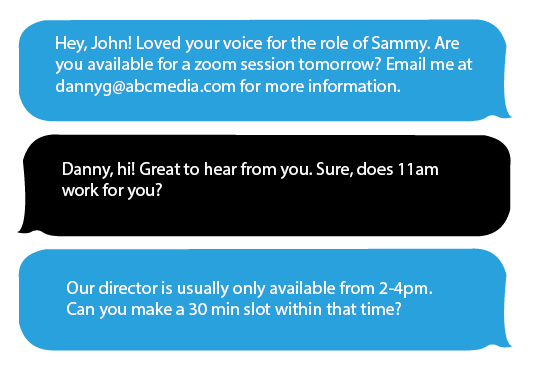
After the session, John needs to get paid. So he messages Danny.
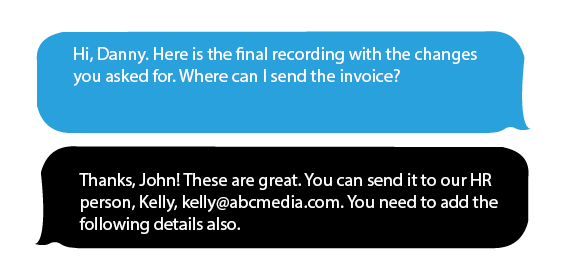
How would a CRM benefit John in this case? He could take this information, create a client profile and set it up like this.
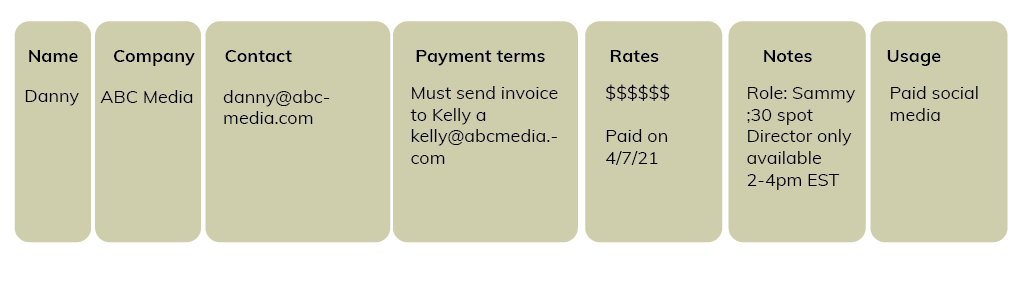
So the next time Danny reaches out, John will know exactly which project he worked on before, what rates he charged, whom to invoice, and whether he was paid for the last job or not.
Tracking auditions and invoices
Your CRM dashboard will help you to track auditions, bookings, payments, and even client interactions from online casting platforms. And when you’re trying to learn how to build client relationships, CRM companies can offer detailed advice and suggestions that are tailored to your voice over business. This is also important when you’re trying to build your brand.
Voice123’s Customer Success team also deals with commonly asked questions that you might be wondering yourself:
-Can you help me check if I was paid for this booking?
-I received this message but I don’t know which client booked me.
-I auditioned for this project but now the rate has changed and I don’t remember what the original amount was.

Deb DeVries, a voice actor on Voice123 notes how a CRM helps her voice over business and improving client relations:
“It helps me stay on top of my invoicing … I just realized I still have an outstanding invoice and it was a net 30. Without that prompt or that reminder that might’ve gone by the by … You can track your audition to booking ratio. You can look at a whole span of time, say a year and say, okay, what are some of my trends revenue wise, or what are some of my trends for auditions?”
Do's and Don'ts on building relationships with clients
Your CRM can become a sort of voice over manager. Consequently, it can help you to avoid unnecessary interactions with your clients, asking redundant questions, and mixing up information. Or it can become a source of spam communication that puts a client off. It’s like a baseball bat. It can score a homerun and win the game, or break a window and land you in trouble! It all depends on how it’s used.
You are everything from the marketer to the accountant, talent, editor and all of the things that comprise that voiceover business. - @DaniStatesVO Share on X – Dani States, Founder of VOICEOVERVIEW and a voice actor on Voice123
Dani States built VOICEOVERVIEW because she needed a place to stay organized, but none of the existing tools were doing it for her.
“It’s a full-on business management system. You can track your jobs from the time that you book it to when you deliver, get approval, invoice and actually pay.”
Dani’s helpful CRM Do’s and Don’ts:
Do “make your CRM part of your daily workflow, especially when you’re brand new.”
Do “put the people in that you’re actively in conversation with, people that are actively looking to hire but not those people that someday I might reach out to. Keep that in a separate area”.
Don’t “make it something that you have to catch up on at the end of the day or month because it will soon become overwhelming.”
Don’t “add every contact you’ve ever made contact with.”
Exclusive deals from CRM companies
You’ve got the most popular CRMS designed for various industries such as Nimble, Hubspot, and Salesforce. Or something specifically designed to be a voice over manager for voice actors. This can also help you learn how to build client relationships in the voice over industry. Some like UpperLevel hosting offer a CRM and website hosting for voice actors.
In fact, Deb also mentions that she uses a voice over CRM because “it is highly customized for our particular industry. There are some fine CRMs but they don’t use terminology like audition, booking percentage … all of those descriptors are relatively unique to the voiceover industry. It gave me a tool that provided me the opportunity to put all of my customer information in a single place.”
To help boost your voice over business, Voice123 has partnered with the following voice over CRM companies. Learn more about them here:

Created by Dani States, VOICEOVERVIEW is a voiceover-specific business tracking and management platform with a CRM component. Unlike traditional CRMs (Nimble, Zoho, Constant Contact, etc), they focus on the core competency, which is the unique business metrics of voiceover. This is a platform will help you understand your business better AND helps you keep track of clients.

Spearheaded by Brad Newman, UpperLevel CRM is a uniquely designed platform created and inspired by the voiceover community, fully understanding your needs and the journey required to be your best.

Jason McCoy created SpitFire CRM after realizing his time was best spent in front of a microphone rather than following up on invoices.
“I was using a CRM to keep track of business relationships and an invoicing app to bill clients. SpitFire puts everything in one place so I save time running my business.”
See below for special deals from these CRM companies!
Voiceoverview
Sign up via this link and receive a 3 month free trial.

Spitfire CRM
Sign up & get a 14-day free trial by using the coupon code VOICE123 to save $5 per month off the monthly plan.
UpperLevel CRM
After signing up and verifying your email, put Voice123 anywhere on the form to redeem a free 6 month trial.
Boost your voice over work opportunites with a paid Voice123 membership
First-time paying members are eligible for a discount

Here's how to start a voice over business successfully
Here’s how to start a voice over business successfully
This section will help you understand why and what you need in order to learn how to start a voice over business today!
Why should you learn how to start a voice over business
So you’ve never thought of a voice over career as a business? Well, why not? You provide a service, earn a fee, sign contracts and NDA’s, align with legal compliance = a business! And learning exactly how to start a voice over business is crucial to be able to achieve longevity in the industry.
“Voice acting is a business. We all think of ourselves as artists or actors, which of course we are, but at the end of the day, most of us want to be a full on business.”- Dani States, Founder of VOICEOVERVIEW and voice actor on Voice123
Is it important to learn how to start a voice over business?
If you don’t see your voice over career as a voice over business, and yourself as an entrepreneur, then you’re not thinking sustainably, or long-term. Your voice over business is your main tool to create a successful vocal brand that your audience and clients can not only relate to but also easily identify. So when you’re learning how to become a voice actor you also need to learn how to start and manage your voice over business.

This is where branding comes into play. For instance, you might think that only tech giants like Apple or Facebook have to worry about logos, and websites, but think again! Every business, including a voice over business needs to have brand authenticity and authority.
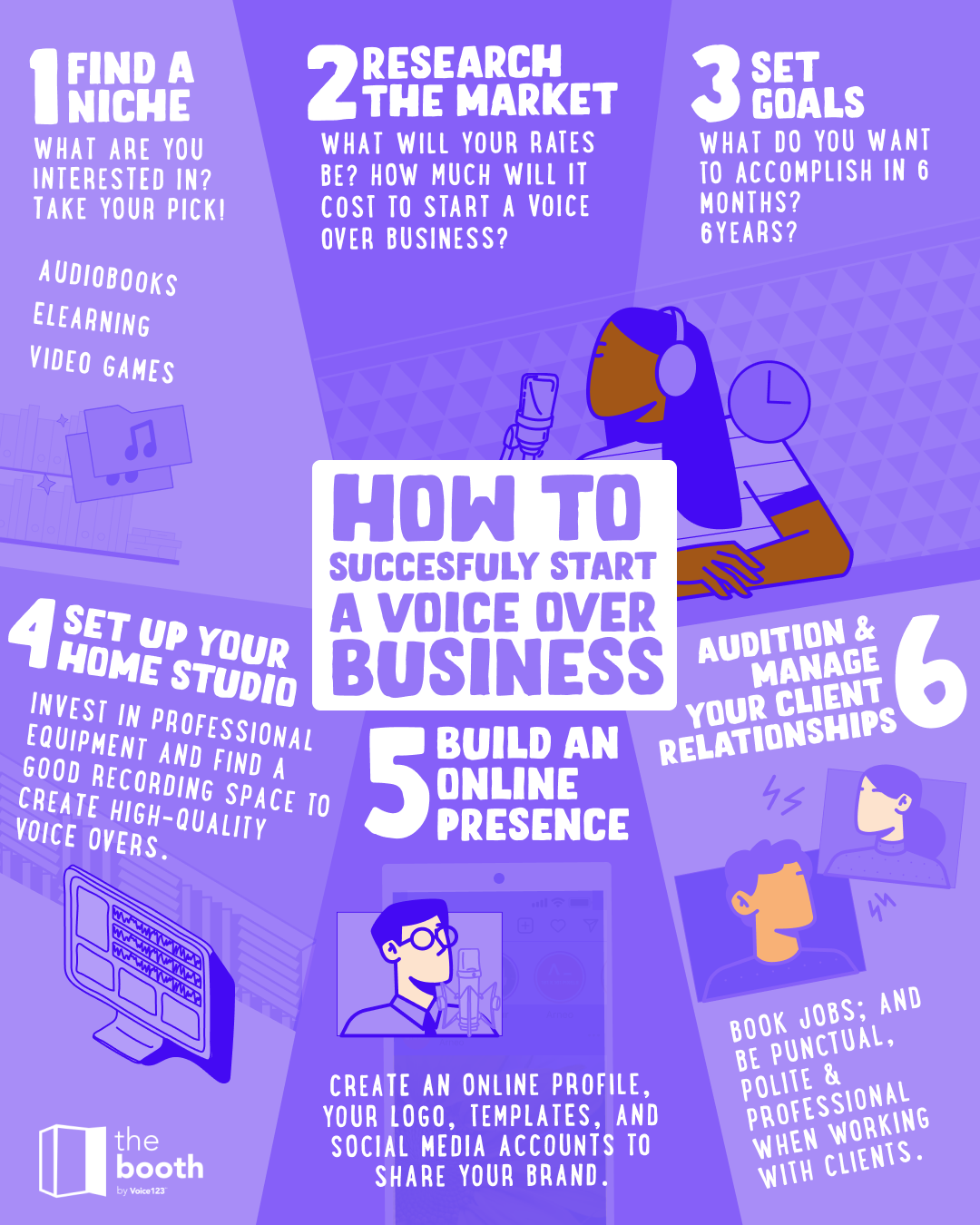
Saundi Harrison-Cooksey, a voice actor on Voice123 notes “It does not come all in one day or one month. You grow, learn and change a lot to adapt to your current business situation … get your systems, processes, and administrative or “OOTB” out of the Booth tasks together.”
How to create a voice over business plan
The internet is full of free online resources for business plan templates from the likes of Shopify, Wix, and FormSwift. These pre-made templates can save a ton of time and provide the necessary direction.
3 things you need to find
1. Find your niche: Create your voice actor identity before you create your voice over company identity. Will you be working with online platforms? Will you be focusing on audiobooks or e-learning?
2. Find your budget: What will your rates be? What expenses will you have?
3. Find a suitable place to work: Can you create a home studio and save on an expensive office and studio recording fees? If so, what equipment will you need?

3 things you need to decide
4. Decide on your budget: Will you have to take out a loan and can you afford to repay it? Can you rather save money to avoid getting into debt?
5. Decide on your goals: What do you want to accomplish in one month? Three? Six? A year?
6. Decide on the type of business: For example an LLC. Then think of a catchy name. Try to include ‘voice, voice over, or voice actor’ as this is what clients will search for.
3 things you need to create
07. Create your online presence: Create a unique logo and design to be used on your website and business cards. And set up social media accounts for exposure. This includes having an online voice actor profile.
08. Create a marketing strategy: This will help you to reach new clients, take advantage of SEO searches and learn how to find voice acting jobs.
09. Create a payment system: Paypal is often the easiest, but takes out the most fees. Can you rather set up a Wise account? Will you be able to accept credit card payments?


3 things you need to do
10. Do learn about different delivery methods: Will you only deliver Mp3 files or can you invest in source connect, ISDN, or phone patch?
11. Do get an accountant: This will help you keep track of profits, expenses and taxes. Or use an accounting software.
12. Do hire a lawyer: Together, you can establish a standard contract that you can use for your projects. This should cover aspects like delivery before or after payment and the cost of pickups or revisions.
Darrell Brown, a seasoned voice actor of 13 years notes that, “this business is unique in that it can be a very low overhead, started in a closet. It is a good idea to speak with an accountant and/or attorney … there can be advantages based on how you structure the business … so it’s worthwhile to invest in getting answers and help from the business and tax pros.”
Best practices to learn how to start a voice over business
- Update your voice actor profiles and website regularly
- Ensure that you have professional samples for clients to choose from
- Design a workflow that suits your studio so your turnaround time doesn’t fluctuate
- Create a proper working environment
- Source the best equipment for your voice and keep it in good shape
- Decide on the user experience that you want to be known for. Fast, friendly and reliable? Or versatile, efficient and thorough? Then become that experience for every client
- Create a mailing list of clients in your CRM to send your latest work and samples
- Be professional; this means you’d reply in a timely manner, speak or type courteously, respect a client’s time and needs, and do your best to nail their brief!
- Always try to improve your skills and services
Build and organize your client relations
Once you learn how to start a voice over business, you also have to focus on repeat business. But that can only be achieved when you create and maintain solid client relationships. This can easily be done through a CRM; a customer relationship manager. It’s a simple web-based software that allows you to upload and track client and project information. This can create smoother processes and cement positive and ongoing relationships between you and your clients.
Learning how to build client relationships and track auditions, invoices, and payments are covered in “How CRMs help voice actors build relationships with clients.“
Starting a voice over business and taking on the role of an entrepreneur is the first step to having a successful career in the voice over industry.
Then, to help you take the next step towards marketing your voice over career, we’ve got expert tips and guidance in “What you need to showcase on a successful voice actor website.“You’ll also learn how to optimize your Voice123 profile as a free online portfolio, and be able to access special discounts from professional voice over website designers.
Voice over business fundamentals
You also need to craft your voice over business carefully so you can stand out from the crowd. How? By creating an authentic voice over brand and marketing it organically. But how do you find your voice over your brand? And how can you use social media professionally? In How to best improve your personal branding for artists, you’ll find trusted advice, a social media strategy checklist, and do’s and don’ts for your voice over logo, business cards, and color palette!
And then to bring it all together, we partnered up with voice over experts to bring you What you need to know when setting successful voice over rates. This section has valuable tips, advice, research, and real-world examples that will help you navigate the ins and outs of setting and negotiating voice over rates.
Keep an eye out for the two key factors that make up the foundation of determining voice over rates, along with where to find pricing examples and breakdowns.
Client Communications Checklist For Voice Actors
You’ve set up your voice actor profile, CRM, and website; now you’re ready to start communicating with clients.
But how can you be sure of what to say, how to say it, and when to say it? That’s where the Client Communications Checklist can help. Each section covers vital communication do’s, don’ts, and tips for each stage of a voice over project.
Moreover, if you’re looking for expert advice and first-hand experiences to be successful at quoting, negotiating, live direction, and creating voice over contracts, we’ve got you covered.
And the best part is that we have a Checklist Collection with easy, copy and paste templates to use for your next client communications.
We've partnered with some CRMs created by voice actors, for voice actors!
Check them out to score exclusive trials and discounts, only for readers from The Booth!
Access our client communications template for free!
We're creating a living, breathing document full of message templates that you can take and tweak for your own situations.
Boost your voice over work opportunites with a paid Voice123 membership
First-time paying members are eligible for a discount

How to fill out your voice over profile checklist

Download your free voice acting profile checklist
Stand out from the crowd! Completing your online voice actor profile increases your chances of getting a voice over work. Download the checklist for free here.
Boost your voice over work opportunites with a paid Voice123 membership
First-time paying members are eligible for a discount