
How to improve your voice over auditions checklist

Download your free voice over auditions checklist
Boost your voice over work opportunites with a paid Voice123 membership
First-time paying members are eligible for a discount


How to improve your online voice actor profile
How to get voice acting jobs
Voice acting jobs are posted daily on various online platforms. Your goal shouldn’t be to simply learn how to apply for voice over jobs, but how to get voice acting jobs.
How to get voice acting jobs with an online profile
At Voice123, your online voice actor profile allows the platform to match you with incoming projects to submit your voice over auditions. Clients can also find your profile when searching for suitable voice actors and create a direct booking!
Now, the key that unlocks a successful profile is the balance between too little and too much.
Too little information could leave a potential client wondering, “But what about …?”
Too much information could overwhelm a potential client and lead to, “That’s quite a lot to take in!”
So, how do you strike the right balance?
Regardless of the platform that you choose to register for, think of your profile as a résumé that can show a client the 3 main aspects of your voice:
- The sound, tone, and ‘personality’ of your voice
- Current vocal abilities
- Past vocal accomplishments
The sound, tone, and personality of your voice
Most online voice acting profiles allow you to write a headline about yourself. This is what a client reads first, so be sure to use an actionable and unique description.
Voice actor for 3 years. Deep, warm, calm, professional, authentic.
VS
The authentic voice you can trust for your next project!
Which description draws you in and grabs your attention most?
Current vocal abilities
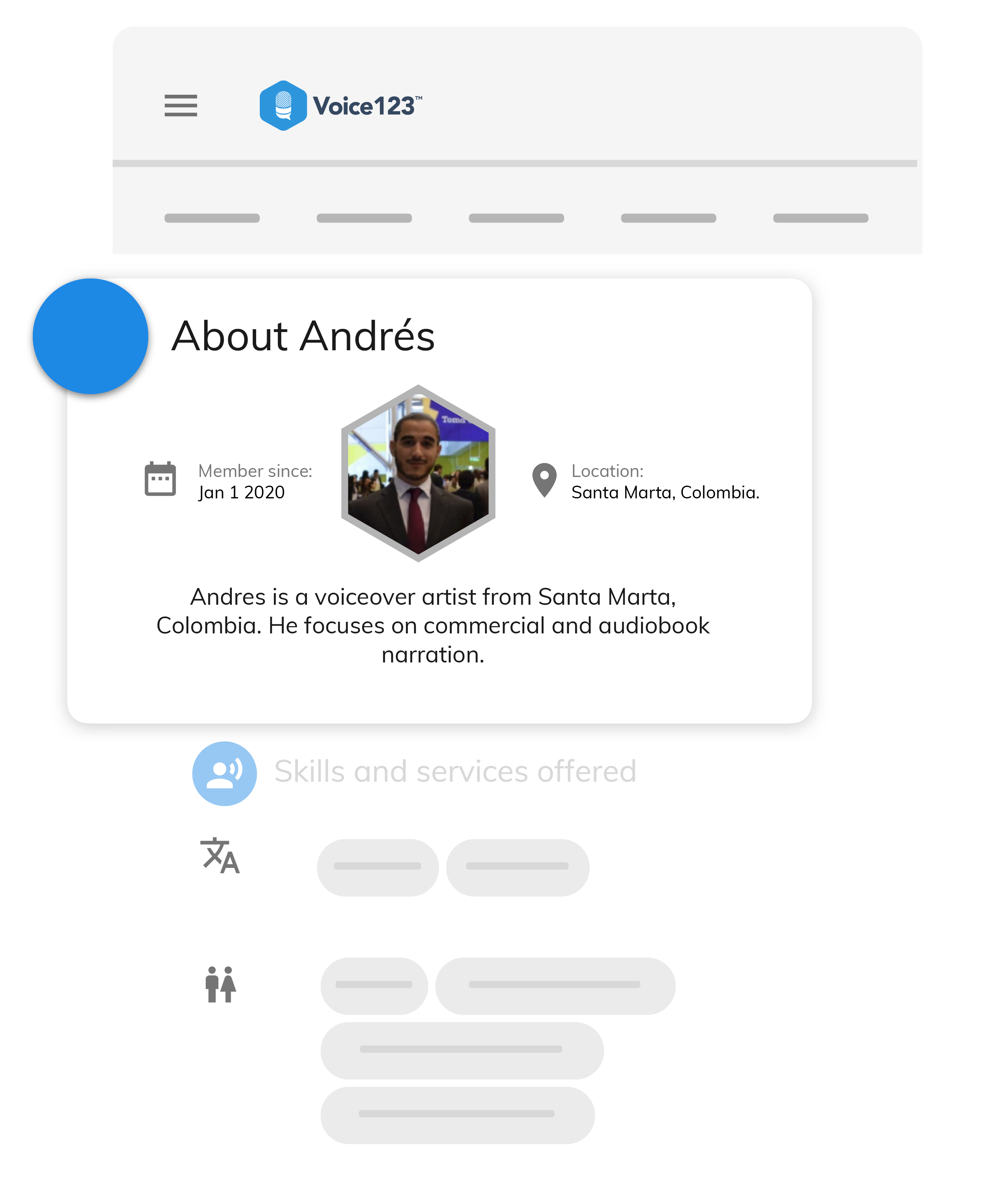
Use the ABOUT section to highlight your key vocal skills and abilities.
Remember, this is not about you, it’s about your voice! This isn’t the time to talk about your hobbies, your bubbly personality, what you do on the weekend, or why you love voice acting.
The information you enter in the about section of your voice actor profile should cover the following points:
- Vocal abilities.
- Main vocal styles, celebrities, and accents.
- Contact details.
- Studio description.
- Equipment description.
- Time-frames, turnarounds, and schedule.
- Additional services.
- Descriptive adjectives for your performance and acting abilities.
Key points
Remember, this is about how to get voice acting jobs, so stick to key skills. And as we taught in our Platform Education Series, always write the description about yourself in the ‘third person.’
Remember, this is about how to get voice acting jobs, so stick to key skills. And as we taught in our Platform Education Series, always write the description about yourself in the ‘third person.’
“I include anything that might set me apart... it's worth mentioning if you’re particularly experienced at something, e.g. interpreting technical scripts, medical narration, etc.” - Lucy Wolfe
Past vocal acomplishments
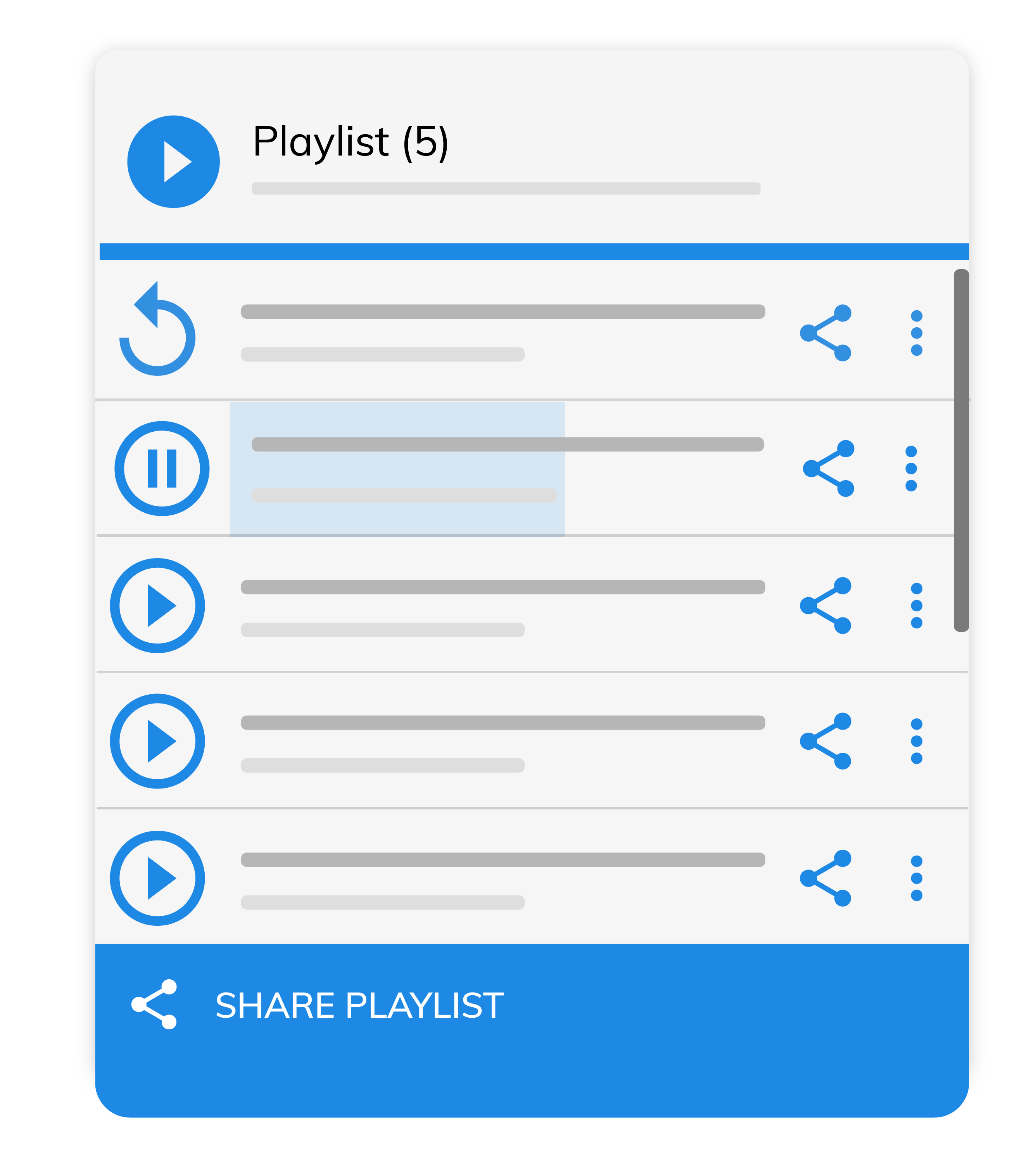
This section allows you to showcase your best work. On Voice123, that’s done through playlists grouping voice over samples of past voice acting jobs. This is also how to get a voice acting job because it’s the perfect opportunity to ‘show’ the client instead of telling them.
What you shouldn’t include on your voice actor profile
“A voice actor can market themselves as ‘The Voice of Amazon,’ but might not sound good doing a spot for McDonald’s. Plus … nobody is perfect for any project. I find that most of the voices I use are great for two or three types of projects and mediocre at all the others. Sell your strengths and don’t try to be all things to all producers! – Tom M, Voice123 client.
Avoid falling into the trap of ‘telegram typing.’
“I’ve been a voice actor for 5 years. I have a versatile voice. I can give you a quick turn-around. Call me on 1091029202. True authentic voice.”
Sure, it’s simple and to the point, but this is not how to get a voice acting job. The client has probably looked at 10 similar profiles so at this point, they can either scroll for more information, or skip to the next profile. You need to stand out from the crowd by avoiding basic sentences that won’t grab a client’s attention.
Avoid keyword stuffing
Most online profiles can rank for SEO on search engines and client searches on various platforms.
Now, keyword stuffing can be tempting, but it’s not how to get voice acting jobs successfully! The principal is simple. Your profile isn’t a dictionary of adjectives that describe your voice, it’s a simple summary of what your voice can do.
Take a look at our Platform Education series to go through our how-to guide with valuable tips and advice to optimize your profile.
What should I prioritize when completing my online voice over profile?
We've created a free downloadable checklist so you'll always have this on hand!
Learn from successful voice actors
To help you get a better visual idea of how these tips and suggestions can come to life, we spoke to three voice actors on Voice123.
Lucy Wolfe, advises you to “include a photograph of yourself (rather than a microphone or something arty!) It’s important to make your profile feel personal. I’ve tried to make my ‘About’ paragraph as succinct and easy to read as possible. I’m guessing clients looking for a particular voice don’t want to spend hours trawling through your life story! The main thing I’ve focused on is the client’s needs.”
Christian Figueroa, shares that “I include brief information about myself in the third person and write about my skills with a narrative, as opposed to just listing a lot of words as if they were hashtags (the same applies to samples). I am specific about what I do and also mention my clients.”
FAQs on how to get voice acting jobs
Every voice actor wonders if it will be hard to learn how to get started in voice over work. If they’d all given up, today, we’d have silent trailers, animations, explainers, and so on. And while there are some voice actors who get hired after several auditions, be prepared to audition anywhere from 50-200 times before booking your first job.
“It’s not about qualifications, it’s about aptitude and experience. Understanding how to read a script in a way that will connect with the intended audience is key. Provide excellent audio quality and clearly labeled files within the deadline and let the client know when to expect them. Always be friendly and polite, easy to work with, and be happy to take direction!” – Lucy Wolfe
Concerned about how much does a voice actor earn?
The rates for voice acting jobs depend on factors like union vs. nonunion, minimum session fees, studio fees, countries, and especially usage. Learn more on Voice123, Gravy For The Brain, Global Voice Academy, and Voice Acting Club.
“It’s not a get-rich-quick thing but like anything else, if you put in the time you’re going to be successful. I would be leery if someone says, ‘Hey, can you do an audio book of 20,000 words for a hundred bucks? You do the math … what’s your time worth? That’s like any profession. But you can make a living at it. No question.” – Andy James
Does experience help? Yes. Is it a requirement? No.
A voice acting career starts with one voice acting job, which starts with one voice acting audition. Then two auditions, then three, then one hundred, and before you know it, you’re an experienced voice actor doing multiple projects simultaneously!
“In my opinion, a voice actor has to work on two main areas: voice technique and the science of audio recording. It is essential to learn about audio and invest to get all the necessary equipment to compete with a good quality product.” – Christian Figueroa
Upgrade your Voice123 membership today!
First-time paying members qualify for a discount

Practical use guide to voice over samples
Practical use guide to voice over samples
Knowing the difference between voice over demos and voice over samples is helpful. Now to put it into practice on your own voice acting profile!
How do I add voice over samples to my voice actor profile?
Voice123 Playlists - Explained
Every online casting platform has its own way of allowing you to upload your work, but Voice123 adopted a specialized Playlist and SEO strategy.
As opposed to just adding voice over samples for the sake of having audio files for clients to listen to, Voice123 has introduced a special ‘Playlist and keyword tagging system.’
This allows voice actors to use the specialized Playlist system to organize and market their samples strategically. Think of playlists as a contemporary way of listening to audio. You don’t need a producer or a huge budget. In a few minutes, you can create specific playlists and upload a series of browsable samples tagged with commonly searched keywords.
Clients can then find those samples when they search for specific keywords required for their project – which often leads to direct bookings! Having these separate playlists also helps clients to get straight to what they’re looking for: your voice!
To learn how to create playlists, add voice over samples to your playlists, and follow keyword tagging best practices check out our Playlist and Samples Guide.
Maximize your digital presence with SEO
With the modern improvements in search engine algorithms, voice actors are now being hired by clients via Google searches. It’s also what makes Voice123’s Playlist system not only unique, but also SEO compatible as it allows voice actors to add different samples with their own individual tags, keywords and descriptions. This increases your chances of being found in client and Google searches.
The process of SEO might seem complicated, but it’s like searching for ‘sneakers’ on an e-commerce website. A simple ‘sneakers’ search would bring up hundreds of shoes, but you need something specific. So you type ‘red comfortable sneakers’ into the search bar and hit enter. Now, the results are more specific.
With the modern improvements in search engine algorithms, voice actors are now being hired by clients via Google searches. Share on XIt’s the same for clients. If they search for ‘voice actors,’ they’re not going to be able to find exactly what they need quickly and efficiently. Whereas if they search for voice actors with voice styles such as ‘warm, friendly and conversational,’ they can get specific results faster.
“I have gotten some really interesting people who have called me from all over the world and have said, "Hey, I was doing a search and you came up." I kind of use that in my keywords and my tags. So I actually get people who actually find me who are looking specifically for that sound. And I get a lot of jobs like that.” - Yolanda Spearman
It’s advised to create and upload short voice over samples in different categories. Then each sample can have a short, targeted description with related keywords that can be found in an online search
So now that you’re ready to add your voice over samples to your profile, check out our Platform Education Series. This provides a detailed guide on how to use SEO strategies, keywords, and how to optimize your profile to be hired for your next gig!
Where can I get feedback on my voice over samples?
If you’re looking for some constructive feedback on your voice over samples, Reddit and its voice acting communities are a good place to go. Online platforms also provide avenues for giving and receiving feedback such as Gravy For The Brain, Edge Studio, Voice Acting Club and Vo 101.

Look no further for voice over resources!
Voice over sample scripts, words to time calculators, industry lingo and more!
Learn from successful voice actors
Voice123 is home to a large array of professional and successful voice actors. We spoke to three of these pros, each with a top 10% ranking score to glean some helpful tips and knowledge.
Yolanda Spearman cautions voice actors to invest in themselves and avoid:
“Poor equipment! You need a DAW and an audio interface because if you try to record directly into your computer, it will sound awful, so that’s a big no – no. And you need to understand the lingo. You gotta learn your art & your craft – you gotta get some education.”
Given that SEO concepts are important to grasp, we asked Gavin Bentley for some SEO advice.
“Keywords are so critical right now. If you don’t tag this stuff, you’re just in this abyss of nothingness. And even if you’re a great talent, you’re just not going to be found because there’s no way for them to actually know who you are or what you can do… It kind of showcases your voice and is tagged well in the description where you’re writing in full sentences in third person, so that Google can kind of grab some of that SEO juiciness off of it.”
Andy James, a voice actor since 1988, shared his thoughts on SEO and categorizing voice over samples.
“It’s teaching an old dog new tricks. When you’ve done it as long as I have and someone says SEO optimization, it’s like, what? Huh? I took a webinar with two other members on the platform, Katherine Tole and Natasha Marchewka. I learned about how to optimize my platform for searches and I get client invitations all the time.”
Andy also shared the benefit of having specific playlists for his samples:
“I’m able to update with spots that I’ve actually done that you pull out one conversational read for another conversational read and just constantly keep it fresh that way. You’re kind of staying with the trends in voiceover.”
We also asked a client from Voice123 to share their experience and voice over needs.
“Since each of our projects are different, we listen to their samples for specifics to each project … I check their profiles to see if they have a history of working in the industry or if they are new to it.” – Claire R., Geomatrix Productions
And if you’re wondering what puts a client off your samples? Claire shares that it’s:
“Poor quality recording. Shows lack of experience or lack of proper equipment.”
Do’s and Don’ts of voice acting samples
Do’s
- Research
- Find samples scripts that suit your voice and your niche
- Find your niche
- Prepare a good recording space
- Ask someone for feedback after you have recorded to catch any mistakes
- Listen with headphones, not an external speaker
Don’ts
- Rush
- Make each sample longer than 30 seconds
- Edit with new software that you have never used before
- Talk about who you are, and why you want to do voice overs
- Make a quick recording on your mobile phone in a closet
- Pay money for something you don’t need, or don’t know about
- Try to achieve perfection
Boost your voice over work opportunites with a paid Voice123 membership
First-time paying members are eligible for a discount

How to improve your voice over auditions checklist
Download our FREE voice over auditions checklist
Learning how to create winning voice over auditions doesn’t happen automatically. So, to help you improve your voice over auditions, we’ve created a trusted, up-to-date checklist with 10 practical tips!
Download our FREE checklist and keep it on hand to help you improve your voice over auditions today!
"Though talent certainly helps, voice acting can absolutely be a learned skill ... It’s up to you to really learn your instrument and how to use it best over time."
– Liz Saydah, professional voice actor.
Upgrade your Voice123 membership and start auditioning more!

How to fill out your voice over profile checklist

Download your free voice acting profile checklist
Stand out from the crowd! Completing your online voice actor profile increases your chances of getting a voice over work. Download the checklist for free here.
Boost your voice over work opportunites with a paid Voice123 membership
First-time paying members are eligible for a discount

Union vs non-union voice acting
Union vs Non-Union Voice Acting
To join a union as a voice actor, or not? That is the question. The answer? It’s complicated.
The debate between union voice acting and non-union voice acting continues on a daily basis. It constantly adapts to the ever-changing landscape of online voice acting. Voice acting jobs transcend country borders and cross into the global market now more than ever.
The reasons why you might join a union for voice acting, and why you might stay away from one, continue to grow in both number and specificity. The widening of the online voice market and increase in the available voice over jobs certainly play a part.
Hopefully by the end of this article, you’ll be better equipped with knowledge to make an educated decision for yourself. A decision that’ll grant your voice entrepreneurship the momentum and success any voice actor would desire, and a decision that makes sense for your life.
We’ll be covering the pros and cons of joining the SAG-AFTRA union (Screen Actors Guild – American Federation of Television and Radio Artists), what you might want to consider before joining it, and what it’s like to be a non-union voice actor.
Quick summary
- A union is an organized group of workers who unite to make decisions about conditions affecting their work
- Unions grant benefits such as health insurance and limited session hours for strenuous work
- Unions protect you from unfair work, and provides opportunities for better-paying jobs
- Unions can be costly, and you can’t accept most non-union jobs after joining
What is a union?
Work unions more or less do the same thing. “A labor union or trade union is an organized group of workers who unite to make decisions about conditions affecting their work.”
For voice actors, unions can offer work protections, such as being paid a fair rate within a reasonable amount of time, safe working conditions, and benefits like health insurance and pension.
A quick look at the Screen Actors Guild – American Federation of Television and Radio Artists, otherwise renowned as SAG-AFTRA, will give you a good idea of what’s available for people who join the union.
Of course, such benefits aren’t free. It costs money to join a union, and unions take a fee out of your pay. So, like most things in a voice over entrepreneurship, it’s an investment. And there are requirements to meet to join SAG-AFTRA, such as having completed one union job.
Sometimes, voice actors come from different industries, like on-camera acting. In these cases, you might already be a member of SAG-AFTRA. Otherwise, you’ll have to meet the requirements to join SAG-AFTRA.
Pros of joining a union as a voice actor
Guaranteed minimum rates
Perhaps the greatest pro union voice actors will cite is the minimum pay and fair professional rates, though not all voice over work guarantees minimum pay or rates. But in most cases, minimum pay for voice over work means more consistent pay, and often better pay than non-union voice acting jobs. SAG-AFTRA has minimum pay rates listed.
Check out SAG-AFTRA’s rate estimates per job and Global Voice Acting Academy’s pay chart. You’ll notice the estimates are in the hundreds to thousands of dollars, which is often more than what some jobs offer.
Gain benefits
Many union voice actors enjoy healthcare, life insurance, retirement benefits, and enjoy having work rules such as days offs and mandatory breaks. Voice acting can be a taxing job, and having these benefits, including protection from over-strenuous work, can be a life-saver in a voice over career.
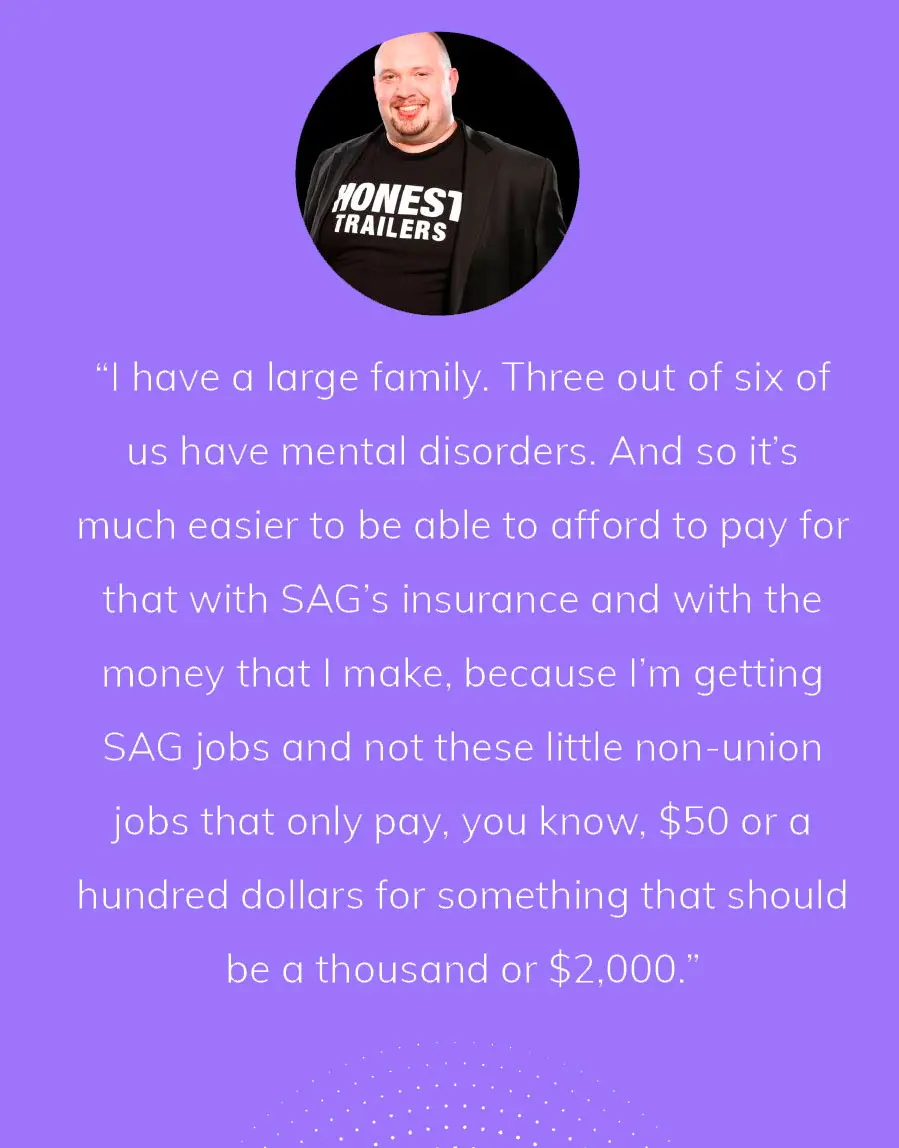
Jon Bailey, otherwise known as The Epic Voice Guy, is a SAG-AFTRA voice actor. He’s played as Optimus Prime, voiced for many other games, and voices Youtube’s popular Honest Trailers. For him, being a SAG member helps him take care of his family.
*Note: you must earn $25,950 in a year through union work before you qualify for health insurance
Protection and security
When work disputes arise, the union is there to help. Unions can enforce limits to working day hours, grant sick days, and ensure you have a safe place to work. They also make sure you get paid fairly.
Cons of joining a union as a voice actor
It can be costly
SAG-AFTRA can cost $3000 to join (though it can be lower or higher in certain states), costs $226.96 in annual base dues, and work dues are calculated at 1.575% of covered earnings up to $500,000. For new voice actors who aren’t making a lot of money in their career, joining SAG-AFTRA might not be an option.
Your job choice is limited
When you join SAG-AFTRA, you follow its policies. That includes sticking to jobs that meet certain requirements, because taking jobs otherwise is a conflict of interest. It breaches the commitment to fair and equitable jobs that people have worked for.
The overall loss of jobs can be a significant con for voice actors who continue to rely on non-union jobs.
Non-union voice acting and Financial Core
If you join SAG-AFTRA, then decide you still want to take non-union jobs, you might declare FiCore status. FiCore, or Financial Core, is a legal status that allows you to take non-union jobs after joining a union, but you sacrifice some privileges like voting within SAG-AFTRA.
Declaring Fi-Core status enables you to do voice over work that union members might otherwise not be able to do, while still enjoying some of the benefits that a SAG-AFTRA member would.
Some people in the industry look down upon benefitting from the union while going beyond its rules that’ve been set to improve working conditions and fees for voice actors. Declaring Fi-Core status is not standing in solidarity with the union.
In some cases, declaring FiCore status can have adverse effects on your career opportunities, such as acquiring a poor reputation and even being barred from work. It’s not legal to bar someone from work because they’ve declared Fi-Core status, but voice actors have said it happens anyway.
Why would a voice actor declare FiCore-status or stay non-union?
As a non-union or FiCore voice actor, you might sacrifice more chances to have minimum, secure pay (not every voice over genre or job offers it) for the ability to access more non-unionized jobs (and union jobs at the same time if you’re FiCore). Having access to more jobs is a huge factor to consider because online voice acting platforms like Voice123 have opened up many opportunities for freelance work.
The amount of non-union jobs you can find on these platforms can easily add up to union work, especially if you’ve built lasting and recurring relationships with clients. In some cases, you can convert non-union work into union work, so joining a union doesn’t necessarily mean you have to sacrifice all of your previously developed non-union relationships.
It’s definitely possible to make a career without joining a union. Jon notes, “There are those people out there that are just completely non-union and they do great. They’re just very smart and they do their research.”
We encourage voice actors to research their worth. Some big companies, to save money, may offer non-union jobs that pay much less than the same job if it was union work. As a resume builder, these types of non-union jobs can be helpful. But it’s important to know how much your service is worth, and to be paid fairly as your career progresses.
Should you join a union as a voice actor?
It depends. If you haven’t built up a sustainable income as a voice actor or through other work, or if it meant not being able to do the non-union work you’ve been doing for years, it might be the wrong move to make. If you’re financially prepared, or know that the genres of voice over you want to get into generally offer union work, it could be the best move you make for your career.
In any case, the benefits are obvious. Joining SAG-AFTRA means securing rights for you as a voice actor. Rights to fair pay, fair working conditions, and fair benefits to cover the cost of the job.
The question is more a matter of whether or not the genres of voice over you work in offer primarily union work. Animation, video games and commercial jobs often do.
On top of that, a big consideration is letting go of the non-union work and relationships you’ve built over years. The situations are niche and specific to each voice actor, so we encourage you to research what’s best for your particular situation if you’re considering joining SAG-AFTRA.
In Jon’s case, he says working in the union is what makes his voice acting career worth it, and that union work saves him a lot of money.
“That's a huge chunk of this job — how much money it saves me. I don't have to pay out of pocket for benefits that come with it." - Jon Bailey
Our recommendation is to carefully consider the financial implications of joining a union, and how it might affect your relationships with your existing clients. By then, hopefully you’ll have enough experience being the CEO of your own business to see if you’re fine handling the risks as a fee-free, non-union voice actor; or whether you’d like to enjoy the benefits of becoming a union voice actor.
Either way, we just hope that you’re careful with accepting voice acting jobs. It’s an exhilarating and wonderful career. But non-union voice actors, if not wary, can be taken advantage of. And if unprepared, union voice actors may find themselves feeling restricted by the union.
However, if you prioritize your wellness, we’re sure either choice can be the right choice for you!

Everything about voice acting
Everything about voice acting
This section covers the ins and outs of what you need to start voice acting, from how to audition for voice acting jobs, to whether or not you’d benefit from a voice over coach and why we think voice over demos are a thing of the past.
The human voice is unique. As our primary means of communication, nothing can engage us like it; nothing can enrapture or enrage us like it. The human voice is our most personal instrument. Its range and infinite versatility make it a singular instrument. Those of us who have the ability to earn a living simply by speaking are remarkably fortunate.
How to start voice acting
Can you really earn a living doing this?
Yes, you can – but it takes immense dedication and perseverance. The voice is present at the core of our personal power and can project whatever we propose; it expresses both the rhythm and the purpose of our existence.
This industry is not about easy and fast money. Despite what your friendly “15 easy online jobs to do from home to earn hundreds of dollars quick” listicle says, voice acting is an art and a craft one must continually develop and refine. Voice over training and technical expertise are essential; the way you sound and the way you apply the tools you require to record your voice add so much to the impact of your message. All these things are critical components of your credibility and authority as a professional voice talent. As also outlined in How to become a voice over artist.
The auditory experience you’re presenting includes…
Voice acting auditions
You audition for voice over jobs. Clients who resonate with your voice may end up checking out your voice actor profile and listening to your demos and samples. This is the ideal journey of finding (and potentially retaining) a recurring client, starting a mutually beneficial relationship between the two. But how do you make sure you’re prepared to take this on?
How to improve your voice over auditions covers the fact that it should be to no one’s surprise that an audition is like a business pitch. It’s your time to shine. This isn’t a space to practice for future auditions, no, not at all.
We’ve also got a list of tips and tricks to improving your voice over auditions and securing more work, as well as an exclusive interview with successful voice actors Courtney Greer and Gwendolyn Carter about their auditioning processes and advice.
Voice over demos
Do you need one?
A quick search on Google’s got everyone echoing the same message: it’s essential to have a voice over demo! It’s your resume, everything about what you can do, your portfolio/showcase of work, etc.
“The demo I had professionally produced, it's out of date now. And [with samples] I'm able to update with spots that I've actually done that you pull out one conversational read for another and just constantly keeping it fresh that way. You're kind of staying with the trends in voiceover.” - Andy James
But we’re taking a different stance on this topic. They’re old-school. Overproduced and expensive for the return on investment you get back in the long run. We’re championing voice over samples; you can learn more about them here and how to put them into action.
How to practice voice acting
There are many ways you can practice voice acting:
- Listen and learn from successful voice actors
- Take online courses and workshops
- Ask for feedback in online community/forum spaces, fellow voice actors, mentors, etc.
- Seek the help of voice over coaches
Do I need a voice over coach?
Determining the right voice over coach for you depends on where you are in your voice over career, and whether or not it’s a good time to invest in coaching. It’s great that there are so many prominent coaches out there with fantastic, inspiring resumes. But just because they have a sparkling resume filled with the biggest gigs in a certain genre doesn’t mean they’re a good coach for you.
A good voice over coach will help you figure out where you fit in the industry, and equip you with what you need to get going.
Understanding the voice over coaching environment
It’s important to understand the reality of this environment, and be prepared to ask questions. Are you learning how to practice voice acting and performance skills? Are you revving up a stalled voice over business? Understanding and reflecting on your needs will help with deciding whether or not you should get a voice over coach, as will other suggestions in our piece on voice over coaches.
Boost your voice over work opportunites with a paid Voice123 membership
First-time paying members are eligible for a discount

How to find voice acting jobs
How to find voice acting jobs
You put in the work, educating yourself on voice acting and performance, and you invest in crafting a solid home recording studio set-up, one that works for you. Now for the fun part - this section covers topics that affect how you approach finding voice over jobs online.
This is an ever-growing list, but here are ways to set yourself up for success as you audition for voice acting jobs online.
By having an online presence with a complete voice actor profile
As far as the online voiceover industry is concerned, you make your own luck. But there are things that you can do to set yourself up for success – one of them being aware of the benefits an online presence will give you. No one will hire you if they don’t know you, so when you’re ready to look for voice over jobs online, this should come as no surprise. A complete voice actor profile will help boost your digital presence and play a part in your journey of landing voice over jobs. Our SEO engineer, Andres Zuleta, even created a 3-part series on how to make the most of your voice actor profile by optimizing your information, playlists and samples. But don’t just hear it from us, hear it from other voice actors who’ve found success in securing returning clientele by keeping their voice actor profiles up to date.
By understanding what being in a union vs non-union offers
Online work has complicated the issue because suddenly we’re all dealing with a global market that crosses borders, boundaries, and oceans on a whim and in the blink of an eye. We cover the advantages and disadvantages of being in a union vs. non-union, as well as FiCore possibilities.
Auditioning day after day is tough. It will always be tough because a possible ‘rejection’ is always involved. Having the right approach is a key element. Never depend on just one platform or offline pipeline for all of your work. Diversify your work sources and do not despair if one source of work dries up or changes. That’s why you have multiple work pipelines – so you can give yourself as much stability as possible.
Gaining traction with your voiceover career takes time and effort. If you commit to the long-term and you persevere, you’ll see consistent results.
Start voice acting with a discount!
*For first-time paying voice actors.
Where to find voice over jobs from home
Entering the world of online casting: what are online casting platforms?
As noted on the first page of the voice over guide,
“Online casting platforms provide job opportunities for voice actors and, because they’re online, the voice actors who make use of these platforms can be anywhere in the world.”
Online casting platforms are also particularly useful for casting directors who need to find precisely the right voice, language or accent they need for a specific job.
Middlemen and other intermediaries who extend the supply chain without adding any real value to it – and often pay themselves handsome commission fees in the process – are eliminated (this idea is how Voice123 came to be – read our founding story here). This is the main reason why online platforms are becoming the new normal for voice actors around the world, and why many blogs include listicles that group together the best places to find voice over jobs online.
Not all platforms suit every voice actor. It’s important to read, share stories with colleagues, and even interact with the customer service team of each site in order to establish a clear sense of what you will be offered, as well as what the advantages are. It’s equally important to set realistic expectations for yourself. Here’s a quick list of some reputable online casting platform (at the time of publication) in alphabetical order:
Guest Post from Edge Studio
Edge Studio has been providing valuable advice on voice over education and production in the industry for over 30 years. Interested in learning from their key insights?
David Goldberg, the founder of Edge Studio, shares his first-hand experience on how to create a voice over business with a solid foundation so that the work finds you.
Read his Guest Post in the piece, How to find the best voice over work.
What is a platform?
A platform uses technology to connect people, organizations and resources in an interactive ecosystem, providing an open, and participative infrastructure. It’s the prevalence of these platforms today that have transformed the global economy; everybody’s in touch with everybody in an instant and can sell products and services to anyone anywhere in an instant, too.
There are many types of platforms so, within a voice actor environment, here’s a short description of each of the main ones, based on how they charge:
Mark up: The platform buys a product or service (say, a voice actor’s work) and re-sells it on to a buyer for a higher-profit.
Commission: When a buyer pays a seller (voice actor), the platform facilitates the payment, and then charges a percentage (or a flat fee) for each transaction. The biggest benefit of this model is that sellers don’t have to pay anything before they receive value from the marketplace. This is very attractive to voice actors, but it’s also very difficult to get into.
Subscription, or Pay-to-Play (P2P): A membership fee is charged to access some of the benefits of the platform. The value this model has for voice actors is the opportunity to find new customers and get exposure. Most of the time the platform is free for clients, but requires a subscription from voice actors. Some other platforms in this category (like LinkedIn) charge companies a subscription fee to access their talent pools.
Lead fee: Clients post projects/requests on the platform, and voice actors pay in order to bid for them. You only pay when you are put in touch with a potential buyer.
Several casting or booking platforms use the commission-based model, but also charge a subscription fee, thus getting revenue from both variables in the equation. Then there are also production platforms that take charge of the entire process from start to finish and deliver a fully completed project to their client.
Browse our practical how-tos to increase your chances of finding voice over jobs online.

Voice Over Resources
Voice over Resources
Go ahead and prep your professional voice over toolkit with our community-vetted & researched compilation of free resources for voice actors!
10 Things any voice actor will tell you by Erin Fitzgerald
Voice-Over Voice Actor: The Extended Edition – Yuri Lowenthal & Tara Platt
Voiceover Achiever : Brand your VO career. Change your life by Celia Siegel
Voice Over Legal – Robert Sciglimpaglia Jr
Voice-Over 101 – Debby Derryberry
The Voice Actor’s Guide to Home Recording by Harlan Hogan, Jeffrey P. Fisher
Secrets of Voice-Over Success: Top Voice-Over Actors Reveal How They Did It by Joan Baker
Running a Successful Voiceover Business by Joshua Alexander
The Voices In My Head Blog by Joshua Alexander
I’ve written over 150+ voice over blog posts over the years – Natasha Marchewka
What’s Happening (note: this page hosts events Voice123/The Booth is involved with!)
CRMs – deals from How CRMs help voice actors build relationships with clients
VOICEOVERVIEW – if you have a Voice123 membership, you’re eligible for a 3-month trial on VOICEOVERVIEW! Click here to redeem this offer.
SpitFire CRM -Sign up & get a 14-day free trial by using the coupon code VOICE123 to save $5 per month off the monthly plan. Click here to redeem this offer.
UpperLevel CRM – After signing up and verifying your email, put Voice123 anywhere on the form to redeem a free 6 month trial. Sign up now!
—
Listing of a voice over resource on this site does not constitute an endorsement of the product or service.

Voice over equipment for a home studio setup
Voice over equipment for a home studio setup
Curious about proper home studio set ups for recording voice overs? Get ready to learn about the voice over equipment you need for your home recording studio.
Voice over equipment paves the way for professional recordings and a successful career in voice acting. From top-tier microphones to pop filters and DIY studios, our guide has tips to help you build a voice over home studio kit that captures crystal-clear audio in every performance.
Voice over equipment for a home studio set up
- Computers
- Microphones
- Microphone Accessories
- Audio Interface
- DAWs
- Headphones
Voice over computers
While you don’t need flashy models, your computer’s processor must handle audio recording software without lags, noise, or system crashes. A quiet fan, ample storage space, and an operating system that supports diverse microphones, interfaces, and editing software is crucial.
Here are some voice recording equipment suggestions:

Acer Aspire 5
This non-Mac alternative is budget-friendly, with enough RAM and SSD (solid state drive) for storage and faster recordings. The Acer TrueHarmony technology enhances recording and editing options. It’s available at Acer and Amazon.

Voice over equipment microphones
Voice over mics minimizes background noise and distortions, creating professional-grade sound in videos, podcasts, and other digital content. Large-diaphragm condenser mics are sensitive and pick up fine details and vocal depth. Generally, XLR mics over USB mics are preferred for sound quality. Here are a few industry-used microphones.
Voice recording equipment recommended by pros:
- Sennheiser MKH 416 – Short Shotgun Microphone – available at Amazon.com, B&H photo and video, and Sweetwater.com.
- TLM102 is available at Sweetwater.com, B&H photo and video, and Amazon.com.
- Neumann U87 – available at Amazon.com, B&H photo and video, and Sweetwater.com.
Budget voice recording equipment:
- Rode NT1A – available at B&H photo and video, Sweetwater.com, and Amazon.com.
- Shure SM7B (this is a dynamic mic) – available at Amazon.com, B&H photo and video, and Sweetwater.com.
- Blue Yeti Pro (USB XLR hybrid) is available at Amazon.com, B&H Photo and Video, and Bluemic.com.
Microphone accessories for a voice over home studio kit
- A pop filter blocks out plosives – air pockets from consonant pronunciations (p-, b-, t-, k-, d-, g- sounds).
- A microphone shock mount reduces vibrations picked up from things that cause the mic or boom arm to shake.
- Microphone stands vary depending on whether they’re standing tripods or desk arms.
- An XLR cable determines how much interference is carried into the recording from the mic.
Voice recording equipment audio interfaces
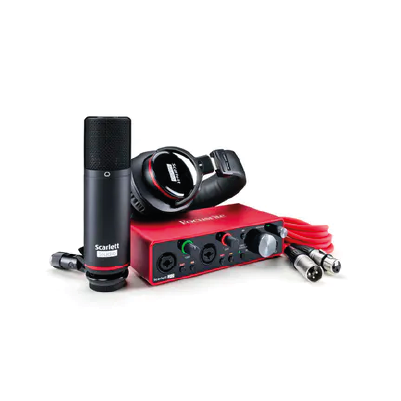
An audio interface receives the sound waves picked up by the mic, converting the analog signal to digital. The Focusrite Scarlett Solo is a budget-friendly voice acting equipment option similar to the 2i2 and 4i4 models. For more info check out SweetWater’s audio interface buying guide.
DAW (Digital Audio Workstation) for a voice over home studio kit
Digital audio workstation helps remove background noise and distracting breaths, apply compression, and do preliminary editing before submitting a recording. Here are 3 industry-used DAWs.
- Adobe Audition improves workflows for multi-track editing and exporting small sound files.
- Audacity has a user-friendly interface that helps you edit audio easily.
- Avid Pro Tools offers free trials, and the entire package is available with subscriptions.
Voice over equipment headphones
Headphones are a must-have for your voice over home studio kit so you can hear every detail of your voice over. Opt for closed-back headphones because they don’t leak sound and are comfortable for long working hours. Here are some options.
- Sennheiser HD280 Pro closed-back headphones are affordable by industry standards. They’re available on Amazon and the official site.
- Audio Technica ATH-M30x is a lower-end option for studio monitors. It’s available at Amazon, Sweetwater.com, and B&H photo and video.
- Sony MDR-7506 is a closed-back option based on Sony’s reputation. Get them at Sweetwater.com, B&H photo and video, and Amazon.
How to get started on your voice over home studio kit
To get started on your voice over home studio kit, choose a quiet space; you can even work in a closet studio or DIY booth with soundproofed or foam-padded walls. Get a high-quality microphone, headphones, and audio interface. Round it off with reliable recording software.
Choose voice over equipment bundles
Voice over equipment bundles are affordable packaged recording items. But voice over equipment isn’t one-size-fits-all. So, choose the tools that give you the best performance output. Here are some voice over equipment bundles to get you started.
- Beginner Bundle: Blue Microphones Baby Bottle SL and SSL2+ Recording Package
- PreSonus USB 96 USB Audio Interface & Audio-Technica AT2020 Recording Bundle
- Advanced Bundle: Shure SM7B and Apollo Solo Heritage USB-C Vocal Recording Bundle
- AKG C414 XLII and Apollo Twin X QUAD Heritage Edition Vocal Recording Bundle
Get valuable audio post-production tips in this article on How to make your voice sound better.
Choose a good space for your home recording studio
Ideally, you want a quiet room with minimal external noises and interruptions. The room should be acoustically treated, or you can record while surrounded by thick coats, blankets, carpets, or clothes to absorb stray sounds. Proper ventilation and temperature control maintain a conducive working environment during long recording sessions.
Cover reflective surfaces
Use soft materials like blankets, carpets, or acoustic foam to cover hard surfaces like desks, which reflect sound waves and cause echoes. Want to compare the differences? Try recording in an open space and then in your closet between hanging jackets – you’ll notice a massive quality contrast.
Isolate your microphone with a shield
Using a mic shield minimizes echo and background noise. Once you have a shield, position the microphone inside its cocoon so it’s centered for optimal sound isolation. You can also place acoustic panels around the recording area to absorb sound.
Conclusion
Reliable voice over equipment is the foundation of a successful voice over career. With a bit of time and research, you can put together a reliable voice over home studio kit. Not sure where to go next? Check out our ultimate voice over resource page for tips to kickstart your voice over business.
FAQ's
You’ll need a high-quality microphone to capture your voice, a pop filter to minimize plosive sounds, an audio interface to convert your microphone’s analog signal to a digital format, professional studio headphones to edit your recordings, and a quiet, acoustically treated recording space.
Although it depends on your specific needs and budget, some of the best recording equipment includes a condenser microphone like the Blue Yeti and an audio interface like the Focusrite Scarlett can enhance the sound quality in your voice over projects.
To do voice overs at home, start with a quiet, acoustically treated space to minimize background noise and echo. Invest in quality voice over equipment with reliable audio recording and editing software, and practice your voice skills to improve your technique and delivery.
You will need an external microphone, a computer or digital audio recorder, and recording software to record your voice. You will also need a quiet, echo-free environment to create high-quality voice over recordings.